
About 18 states now let you build an ADU almost anywhere homes are allowed, and that number was three a decade ago. So the short answer to “what states allow ADUs” is simple: a lot more than last year, and probably more by the time you finish reading this.
The longer answer is where it gets useful, because “allows ADUs” means very different things in different states. Some laws strip cities of the power to say no. Others pass a headline and let local governments quietly keep blocking. Let me sort the real ones from the paper ones, then tell you where I think this is heading.
What “Allows ADUs” Actually Means
Before the list, one distinction matters more than any single state on it. A statewide ADU law can have teeth, or it can be for show.
A strong law preempts local zoning: the city cannot ban ADUs, cannot force owner-occupancy, and cannot pile on parking minimums that quietly kill the project. A weak law announces that ADUs are allowed, then leaves cities enough discretion to make them impossible in practice. The Mercatus Center, which tracks this more carefully than anyone, rates Arizona, California, and Washington as having removed the most barriers.
The single biggest tell is owner-occupancy. When a state lets cities require the owner to live on-site, a lot of ADU financing and building quietly dies, because lenders and builders hate that restriction. Mercatus found that when Los Angeles and Seattle dropped their owner-occupancy rules, ADU construction jumped. So when I read a new state law, that is the first line I go looking for.
Keep that in mind as you read. Being on the list is not the same as being able to build.
The States That Allow ADUs Today
Here is the current roster of states with a statewide ADU law, with the year it passed. Mercatus counts 18 in total; the ones below are the clearly documented ones.
| State | Year | Type |
|---|---|---|
| California | 1982 | Strong |
| Washington | 1993 | Strong |
| Vermont | 2005 | Statewide law |
| Oregon | 2017 | Strong |
| Maine | 2022 | Statewide law |
| Rhode Island | 2022 | Statewide law |
| Montana | 2023 | Strong |
| Arizona | 2024 | Strong |
| Colorado | 2024 | Strong |
| Hawaii | 2024 | Statewide law |
| Massachusetts | 2024 | Strong |
| Arkansas | 2025 | Statewide law |
| Iowa | 2025 | Statewide law |
| Maryland | 2025 | Statewide law |
| Nevada | 2025 | Statewide law |
Source: Mercatus Center taxonomy of state ADU laws (2025)
Only three states had ADU laws before 2017: California, which started back in 1982, plus Washington and Vermont. Massachusetts is a good example of the new wave, where the state now allows ADUs by right in every jurisdiction. Almost everything else on that list is recent, and most of it is very recent.
How Fast This Is Moving
This is the part that surprises people. The pace is not steady, it is accelerating.
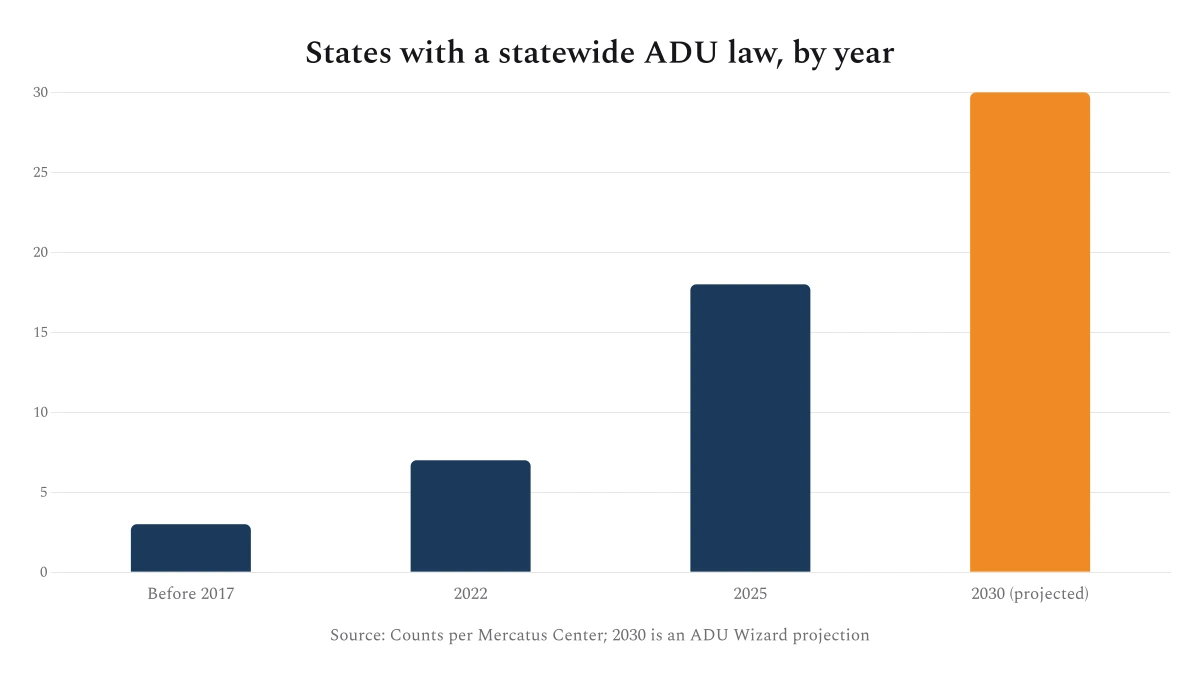
Emily Hamilton, the Mercatus researcher who tracks these laws, put it plainly: there is “steady progress in the number of states legalizing ADUs and the strength of ADU policies increasing over time.” AARP has pushed the same direction for years through its ADU Model State Act, mostly on an aging-in-place argument, and that argument crosses party lines in a way most housing fights do not.
Part of why this moves faster than most zoning fights is the coalition behind it. On one side you have AARP making the case that ADUs let seniors age in place near family. On the other you have housing-cost hawks arguing that ADUs add supply without really changing the character of a neighborhood. Those two camps do not agree on much, and they agree on this.
So here is my estimate, and I want to be upfront that it is an estimate, not a fact. If the last four years brought roughly eleven new states, I would bet on 30 or more states carrying some statewide ADU law by 2030. The catch is that “some law” is not “strong law.” Plenty of those will be the paper kind that cities still find ways around.
States That Could Pass Soon
A handful of states are close, sitting in committee or one session away.
| State | 2026 status | Note |
|---|---|---|
| New Jersey | Bill pending (S-1786) | Would require ADUs by right; municipalities opposed |
| Pennsylvania | Bills moving | Statewide ADU standard proposed |
| Idaho | Passed zoning reform (2026) | Guarantees at least one ADU per lot in covered areas |
| Georgia, Illinois, Michigan, Minnesota, Virginia | Considering | Bills introduced; outcome uncertain |
Source: Mercatus Center and state legislative reporting
New Jersey’s bill would force every town to allow ADUs by right, and predictably, the League of Municipalities is fighting it on home-rule grounds. Pennsylvania has bills moving in Harrisburg. Idaho already passed a broad zoning reform in 2026. The rest are earlier in the pipeline, but the direction is hard to miss.
Where Reform Keeps Stalling
Not every state is on this train, and the ones that fall off almost always fall off for the same reason.

Local control. It is the argument that shows up every single time, and in 2026 it killed two of the biggest bills in the country.
| State | What happened | Why |
|---|---|---|
| Virginia | SB 454 passed the Senate, then died in a House committee | Local control |
| Florida | SB 48 passed the Senate; the ADU language was dropped in March | Dispute over banning short-term rentals |
Source: State legislative reporting, 2026
Virginia’s SB 454 cleared the Senate and then died in a House committee. Florida’s SB 48 passed the Senate unanimously, then the ADU piece got cut in March over a fight about whether cities could ban short-term rentals. Kol Peterson, who wrote the book on ADUs and runs the accessorydwellings.org tracker, has been documenting this pattern for years: the policy is popular, the local-control objection is durable, and the two keep colliding.
I will not tell you these states never pass anything, because the trend says otherwise. But if you are waiting on a strong ADU law in a place with deep home-rule politics and no bill currently moving, do not hold your breath for this year.
What This Means If You’re Building
If you are in one of the strong states, the law is more on your side than it has ever been, so your bottleneck is your lot and your budget, not permission. Our California ADU cost data and Oregon cost breakdown are a better use of your time than reading another statute, and the Data Hub tracks the numbers as they move.
If you are in a state that just passed a law, read the fine print before you celebrate. A headline law with an owner-occupancy loophole can still stop you cold. Our guide to ADU permits walks through what to actually check.
If I were betting, I would bet the map keeps filling in. The real question for most homeowners is not whether their state will allow ADUs, but whether the version they get has any teeth.
FAQ
How many states allow ADUs statewide?
About 18 as of 2025, according to the Mercatus Center, up from just three before 2017. The exact count depends on how you define “allow,” since some laws are strong preemptions of local zoning and others are weak enough that cities can still block ADUs in practice.
Which states have the strongest ADU laws?
Arizona, California, and Washington are generally rated as having removed the most barriers, meaning cities cannot ban ADUs, require owner-occupancy, or set parking minimums that kill projects. Oregon, Montana, Colorado, and Massachusetts also have strong by-right laws.
Will more states pass ADU laws by 2030?
Almost certainly. The count went from 3 states before 2017 to about 18 by 2025, with roughly 11 in the last four years. My own estimate is 30 or more states with some statewide ADU law by 2030, though many of those will be weaker laws that localities can still water down.
Why do ADU bills keep failing in some states?
The recurring reason is “local control,” the argument that cities and towns, not the state, should decide their own zoning. It killed Virginia’s SB 454 and gutted Florida’s ADU bill in 2026 even though both had real momentum. Where home-rule politics run deep and no bill is moving, near-term passage is unlikely.
Explore ADU costs by location
See real price ranges and permit timelines for your state or city.