
Nevada is becoming one of the most important ADU states to watch in 2026. Housing costs have increased across Las Vegas, Henderson, Reno, Sparks, North Las Vegas, and fast-growing parts of Clark and Washoe County. At the same time, state lawmakers have pushed large Nevada cities and counties toward clearer ADU rules.
For homeowners, that creates a real opportunity. A backyard casita, garage conversion, in-law suite, or small rental unit can add flexible living space, support multigenerational housing, and create long-term rental income. But Nevada ADU costs can vary dramatically because the state has two very different construction markets: Southern Nevada desert construction around and Northern Nevada high-desert construction around Reno, Sparks, Carson City, and Lake Tahoe-adjacent areas.
As a 2026 planning range, most Nevada homeowners should expect an ADU to cost $95,000 to $425,000+. A simple garage conversion or interior casita can land near the lower end. A detached backyard ADU in Las Vegas, Henderson, Reno, or Sparks will often fall between $180,000 and $375,000+. A larger, custom, two-bedroom, above-garage, or difficult-lot ADU can exceed $450,000, especially when utility upgrades, grading, sewer work, high-end finishes, or restrictive HOA conditions are involved.
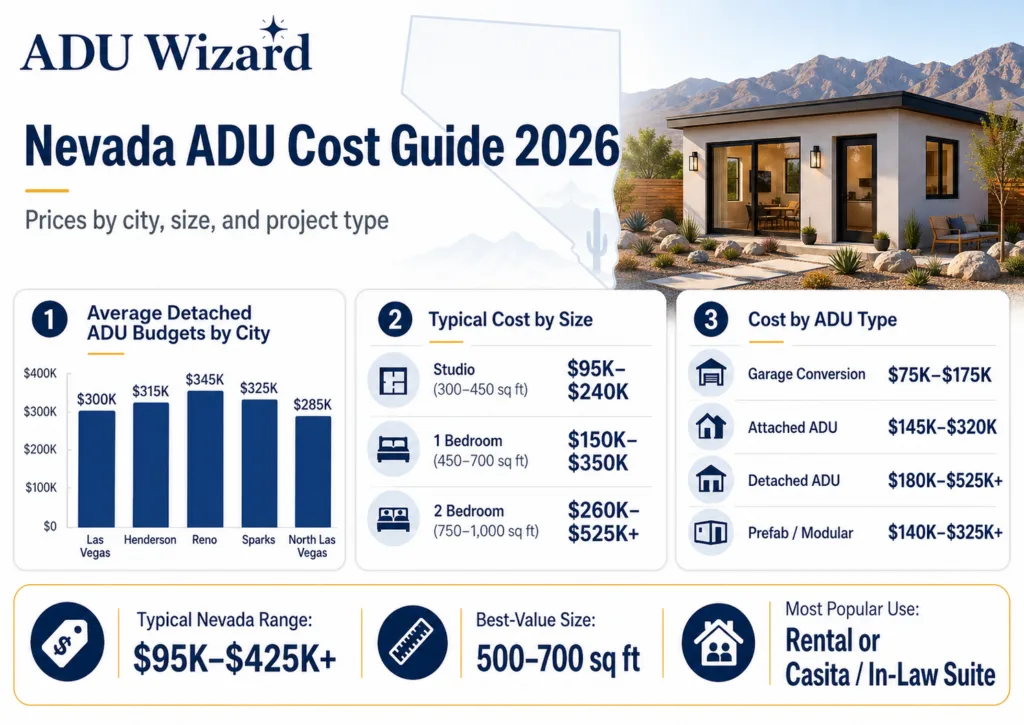
Quick Answer: Nevada ADU Cost in 2026
| ADU Type / Case | Typical Nevada Cost Range | Avg. Size | Best For |
|---|---|---|---|
| Interior casita or suite conversion | $60,000 to $150,000 | 250 to 500 sq. ft. | Family suite, guest space, home office with bathroom. |
| Garage conversion ADU | $75,000 to $175,000 | 300 to 600 sq. ft. | Lower-cost ADU if the structure is usable. |
| Basement ADU | $85,000 to $190,000 | 400 to 800 sq. ft. | More common in Northern Nevada than Las Vegas. |
| Attached ADU addition | $145,000 to $320,000 | 400 to 800 sq. ft. | In-law suite, aging parent, adult child, guest space. |
| Studio detached ADU | $135,000 to $260,000 | 300 to 450 sq. ft. | Compact backyard casita or guest house. |
| 1-bedroom detached ADU | $180,000 to $375,000 | 500 to 750 sq. ft. | Most common rental or family ADU layout. |
| 2-bedroom detached ADU | $260,000 to $525,000+ | 750 to 1,000 sq. ft. | Larger lots, family rental, multigenerational housing. |
| Above-garage ADU | $275,000 to $550,000+ | 600 to 1,000 sq. ft. | Carriage house, garage plus apartment, premium privacy. |
| Prefab or modular ADU, installed | $140,000 to $325,000+ | 350 to 800 sq. ft. | Faster construction when site access is simple. |
| Luxury custom casita / guest house | $375,000 to $700,000+ | 700 to 1,200 sq. ft. | High-end guest house or premium rental unit. |
These ranges assume a legal, permitted ADU with basic residential systems: bathroom, kitchen or kitchenette where allowed, HVAC, insulation, electrical, plumbing, utility connections, permits, and final inspections. They do not include land purchase costs.
Are ADUs Legal in Nevada?
Nevada ADUNevada ADU law changed in a major way for 2026. Nevada Assembly Bill 396 requires larger counties and cities to adopt ordinances that authorize the development and use of ADUs on residential property.pplies to counties with populations of 100,000 or more and cities with populations of 60,000 or more. In practical terms, the most important jurisdictions are Clark County, Washoe County, Las Vegas, Henderson, North Las Vegas, Reno, and Sparks.
The law becomes especially important on July 1, 2026. If a covered city or county does not adopt a compliant ADU ordinance before that date, ADUs are authorized on residentially zoned parcels under the state framework.
That does not mean every Nevada homeowner can immediately build anything they want. ADUs must still comply with building codes, health and safety rules, utility requirements, easements, HOA restrictions where applicable, fire access, septic limitations, and local permitting procedures. But the direction is clear: Nevada is moving toward broader ADU legalization in its largest housing markets.
Important 2026 Nevada ADU rule themes include:
| Rule Area | What Homeowners Should Know |
|---|---|
| Covered jurisdictions | Large counties and cities must authorize ADUs under state law. |
| Kitchen facilities | Local governments cannot prohibit separate kitchen facilities under the state framework. |
| Parking | Covered jurisdictions cannot require more than one additional parking space when existing and street parking satisfy expected needs. |
| Rental use | Long-term rental use is protected, but transient lodging or short-term rental use may still be restricted. |
| Building codes | ADUs must meet applicable residential building, housing, health, and safety codes. |
| Number of ADUs | The law does not authorize more than two ADUs on a residential property. |
| Local ordinances | Cities and counties can adopt local ADU standards if they are consistent with state law. |
In plain English: Nevada is becoming more ADU-friendly, but every project still needs a parcel-level zoning and feasibility check.
Nevada ADU Cost by City in 2026
Nevada ADU pricing depends heavily on the local construction market. Southern Nevada projects often deal with heat, concrete, block walls, trenching, utility upgrades, and HOA design controls. Northern Nevada projects may involve snow load, slope, high-desert weather, crawlspace or basement conditions, septic, and more complex grading.
| City / Area | Garage or Interior Conversion | Detached 1-Bedroom ADU | Detached 2-Bedroom ADU | Notes |
|---|---|---|---|---|
| Las Vegas Las Vegas | $80,000 to $180,000 | $185,000 to $360,000 | $275,000 to $500,000+ | Large labor market, strong rental demand, many HOA communities, desert utility/site costs. Homeowners should also review the city’s official zoning and land-use code materials. |
| North Las Vegas | $75,000 to $170,000 | $170,000 to $335,000 | $255,000 to $460,000+ | Often slightly lower than Henderson, but utility runs and lot access still matter. |
| UnincorporUnincorporated Clark County | $75,000 to $180,000 | $175,000 to $360,000 | $260,000 to $500,000+ | Rules vary by parcel, especially outside city limits and in custom-home areas. Start with the county’s official building code and permit requirements. |
| Sparks | $85,000 to $200,000 | $195,000 to $385,000 | ilar to Reno, often slightly more suburban depending on lot and zoning. | |
| Carson City | $80,000 to $190,000 | $180,000 to $360,000 | $275,000 to $500,000+ | Smaller market, variable contractor availability, possible septic or rural-edge constraints. |
| Pahrump / Nye County | $65,000 to $160,000 | $140,000 to $300,000 | $215,000 to $425,000+ | Lower labor pressure, but septic, wells, utility extensions, and manufactured/modular rules matter. |
| Elko | $80,000 to $190,000 | $180,000 to $375,000 | $275,000 to $525,000+ | Remote labor and material logistics can raise costs despite lower land pressure. |
| Lake Tahoe-adjacent Nevada areas | $125,000 to $275,000 | $300,000 to $650,000+ | $450,000 to $850,000+ | Very expensive due to design review, snow, slope, access, environmental rules, and high-end finishes. |
Average Nevada ADU Cost by Bedroom Count
Bedroom count is one of the easiest ways to estimate an ADU budget. A studio casita is the cheapest detached option, but a one-bedroom ADU is usually the best balance of cost, livability, and rental value. A two-bedroom ADU can work well on larger lots, but it may be limited by local size caps, parking rules, septic capacity, HOA restrictions, and the state framework.
| ADU Layout | Typical Size | Estimated Nevada Cost | Typical Use Case |
|---|---|---|---|
| Studio ADU | 300 to 450 sq. ft. | $95,000 to $240,000 | Guest suite, compact rental, backyard office with bathroom. |
| 1-bedroom ADU | 450 to 700 sq. ft. | $150,000 to $350,000 | Most common rental, in-law suite, adult child housing. |
| Large 1-bedroom ADU | 650 to 800 sq. ft. | $200,000 to $425,000 | More comfortable long-term rental or family unit. |
| 2-bedroom ADU | 750 to 1,000 sq. ft. | $260,000 to $525,000+ | Family member housing, higher-rent unit, larger suburban lots. |
| 2-bedroom above-garage ADU | 700 to 1,000 sq. ft. | $325,000 to $600,000+ | Garage plus apartment, privacy, high-end suburban or custom lots. |
A two-bedroom ADU is not always the best financial decision. The project costs more, requires more space, and may trigger additional design, utility, or parking issues. In many Nevada markets, a well-designed 500 to 700 square foot one-bedroom unit is the best-value ADU.
If you want that comparison run properly, our 2 bedroom ADU cost page prices the 700 to 1,000 square foot band across all five build types and every city we cover, and the 1 bedroom version does the same at 400 to 600. The gap between them is what the second bedroom actually has to earn back in rent.
Nevada ADU Cost by Type
1. Interior Casita or Suite Conversion Cost in Nevada
An interior casita or suite conversion usually costs $60,000 to $150,000.
This may include converting part of the main house into a private living area with a bathroom, kitchenette, bedroom, and separate entrance. In Las Vegas and Henderson, this can be a good option for homeowners who already have a flexible floor plan or a large single-story home.
Costs rise when the project requires structural wall changes, new plumbing locations, electrical panel upgrades, fire separation, new exterior doors, or major HVAC changes.
2. Garage Conversion ADU Cost in Nevada
A garage conversion ADU in Nevada usually costs $75,000 to $175,000.
This is often the lowest-cost route if the garage is attached, accessible, and structurally sound. However, Nevada garages are not designed as conditioned living space. A conversion may require insulation, drywall, slab leveling, new windows, fire separation, new HVAC, plumbing, electrical upgrades, and a legal kitchen or kitchenette.
In HOA communities, garage conversions may be difficult if the HOA requires enclosed parking or restricts exterior changes. Even if the city allows the ADU, the HOA may still affect feasibility.
3. Basement ADU Cost in Nevada
A basement ADU usually costs $85,000 to $190,000, but it is far more common in Northern Nevada than in Southern Nevada.
Reno, Sparks, Carson City, and older high-desert homes may have basements, daylight basements, or lower-level spaces that can be converted. Las Vegas-area homes are less likely to have basements, so this option is not available for most Southern Nevada homeowners.
Basement ADU costs depend on ceiling height, moisture control, egress, exterior access, plumbing, heating, and whether the space can be legally separated from the main dwelling.
4. Attached ADU Addition Cost in Nevada
An attached ADU addition usually costs $145,000 to $320,000.
This can be a side addition, rear addition, in-law suite, or casita connected to the primary home. It is usually cheaper than a detached ADU because utilities may be closer and the design can share some building systems. But it still requires a foundation, exterior walls, roof tie-in, mechanical systems, inspections, and full code compliance.
Attached ADUs are especially useful for aging parents because they allow privacy while keeping family members close.
5. Detached Backyard ADU Cost in Nevada
A detached backyard ADU usually costs $180,000 to $525,000+ in Nevada.
This is the classic backyard casita, guest house, granny flat, or small rental home. It is also the most expensive common ADU type because it behaves like a small standalone house. It needs a foundation, walls, roof, insulation, windows, doors, electrical, plumbing, sewer or septic connection, HVAC, kitchen, bathroom, permits, and inspections.
In Southern Nevada, detached ADU costs are often affected by long trenching distances, block walls, concrete demolition, utility capacity, access around the side yard, and summer construction conditions. In Northern Nevada, slope, snow load, frozen-ground scheduling, high-desert temperature swings, and grading can add cost.
6. Above-Garage ADU Cost in Nevada
An above-garage ADU usually costs $275,000 to $550,000+.
This type of ADU can be attractive because it preserves yard space and creates separation from the main house. However, it is rarely cheap. The garage needs a foundation and structure engineered to support living space above it. The project also needs stairs, fire separation, sound control, utility routing, and careful roof design.
Above-garage ADUs are more likely to make sense on larger lots, custom-home properties, and higher-value neighborhoods where the final value can justify the build cost.
7. Prefab or Modular ADU Cost in Nevada
A prefab or modular ADU in Nevada may cost $140,000 to $325,000+ installed.
The advertised factory price is not the all-in project cost. Homeowners still need site prep, foundation, utility trenching, delivery, crane access, permits, hookups, decks or stairs, inspections, and sometimes local design approval.
Prefab can be a strong option in Nevada when the lot is flat, access is easy, the unit meets local code, and the utility route is short. It can become expensive when the yard is difficult to access, the unit requires a crane, or the property is far from sewer, water, or electrical tie-ins.
Nevada ADU Price Per Square Foot
Cost per square foot is useful, but it can be misleading for ADUs. Smaller ADUs often cost more per square foot because the expensive components are still required: bathroom, kitchen, HVAC, utilities, permits, and inspections.
| Project Type | Typical Nevada Cost Per Sq. Ft. | Why |
|---|---|---|
| Interior conversion | $150 to $300 per sq. ft. | Existing structure reduces cost, but code upgrades and plumbing matter. |
| Garage conversion | $175 to $350 per sq. ft. | Existing shell helps, but garages need insulation, HVAC, plumbing, and finish upgrades. |
| Basement ADU | $175 to $325 per sq. ft. | Can be efficient if dry and accessible, but egress and waterproofing raise costs. |
| Attached ADU addition | $250 to $450 per sq. ft. | New foundation and shell, but shorter utility runs than detached units. |
| Detached backyard ADU | $300 to $575+ per sq. ft. | Separate structure, separate systems, foundation, utilities, kitchen, bath, and site work. |
| Above-garage ADU | $375 to $700+ per sq. ft. | Garage structure, engineering, stairs, fire separation, and custom construction. |
| Prefab ADU, installed | $250 to $525+ per sq. ft. | Unit may be factory-built, but foundation, delivery, hookups, and permits remain. |
For quick planning, a basic Nevada detached ADU often starts around $300 to $375 per square foot. A realistic all-in number for many urban and suburban projects is closer to $375 to $525 per square foot. Complex custom projects can exceed that.
Average Nevada ADU Cost by Real-Life Scenario
| Scenario | Good Planning Budget | Why It Costs This Much |
|---|---|---|
| Convert part of the home into a private casita | $60,000 to $150,000 | Uses existing structure but still needs bathroom, kitchenette, entrance, HVAC, and code work. |
| Convert an existing garage into a studio ADU | $75,000 to $175,000 | Cheaper than new construction, but garages need major upgrades to become legal living space. |
| Convert a Northern Nevada basement into a 1-bedroom ADU | $85,000 to $190,000 | Lower if dry and accessible, higher if egress, waterproofing, or plumbing relocation is needed. |
| Build a small detached studio casita | $135,000 to $260,000 | Small footprint, but still needs a full foundation, utilities, bathroom, kitchen, and permits. |
| Build a 500 to 700 sq. ft. 1-bedroom backyard ADU | $180,000 to $375,000 | Best-value ADU size for most Nevada homeowners. |
| Build a 750 to 1,000 sq. ft. 2-bedroom detached ADU | $260,000 to $525,000+ | Larger footprint, more finish work, higher utility demand, and more zoning review. |
| Build an above-garage apartment | $275,000 to $550,000+ | Requires garage structure, engineering, stairs, fire separation, and complex systems. |
| Install a prefab ADU on a simple Las Vegas-area lot | $140,000 to $300,000 | Factory unit may save time, but foundation, delivery, and hookups are still major costs. |
| Install a prefab ADU on a difficult Reno or hillside lot | $225,000 to $425,000+ | Slope, crane access, snow load, retaining walls, and utility routing can erase savings. |
| Build a luxury backyard guest house | $375,000 to $700,000+ | Premium finishes, custom architecture, outdoor living space, landscaping, and complex site work. |
Sample Nevada ADU Budgets
Sample Budget 1: Garage Conversion ADU in Las Vegas
| Cost Item | Estimated Cost |
|---|---|
| Plans, permit, basic engineering | $10,000 |
| Insulation, framing, drywall, fire separation | $24,000 |
| Bathroom and plumbing | $28,000 |
| Kitchenette or compact kitchen | $18,000 |
| Electrical and lighting | $12,000 |
| HVAC or mini-split | $9,500 |
| Flooring, paint, doors, windows | $18,000 |
| Exterior entry and minor site work | $8,000 |
| Contingency | $15,000 |
| Estimated Total | $142,500 |
Sample Budget 2: 600 Sq. Ft. 1-Bedroom Detached ADU in Henderson
| Cost Item | Estimated Cost |
|---|---|
| Feasibility, survey, architecture, engineering | $24,000 |
| Permit and plan check fees | $8,000 |
| Site prep and foundation | $34,000 |
| Framing, roof, exterior, windows | $82,000 |
| Plumbing, electrical, HVAC | $45,000 |
| Kitchen, bathroom, fixtures, appliances | $43,000 |
| Interior finishes | $36,000 |
| Utility trenching and connections | $26,000 |
| Exterior access, hardscape, drainage | $14,000 |
| Contingency | $32,000 |
| Estimated Total | $344,000 |
Sample Budget 3: 750 Sq. Ft. Detached ADU in Reno
| Cost Item | Estimated Cost |
|---|---|
| Feasibility, survey, architecture, engineering | $30,000 |
| Permit and plan check fees | $9,000 |
| Site work, grading, drainage | $38,000 |
| Foundation | $34,000 |
| Framing, roof, windows, exterior | $110,000 |
| Plumbing, electrical, HVAC | $55,000 |
| Kitchen, bathroom, laundry | $55,000 |
| Interior finishes | $46,000 |
| Utility connections | $30,000 |
| Exterior stairs, walks, access, landscaping | $20,000 |
| Contingency | $45,000 |
| Estimated Total | $472,000 |
This is why Reno and Sparks ADUs can look more expensive than Las Vegas ADUs on paper. Northern Nevada projects often carry higher site, weather, grading, and labor complexity.
Best-Value ADU Size in Nevada
For most Nevada homeowners, the best-value ADU is usually a 500 to 700 square foot one-bedroom unit.
It is large enough to function as a real long-term rental or comfortable family suite, but it is not so large that the budget becomes close to a small standalone home. It also gives homeowners more flexibility than a tiny studio because it can support longer stays, better privacy, and stronger rental appeal.
| Best-Value ADU Plan | Typical Range |
|---|---|
| Size | 500 to 700 sq. ft. |
| Bedrooms | 1 |
| Bathrooms | 1 |
| Typical Nevada cost | $180,000 to $375,000 |
| Higher-cost city version | $250,000 to $425,000+ |
| Best uses | Long-term rental, in-law suite, adult child, guest house. |
The biggest mistake is going too small only to save money. A 300-square-foot studio may be cheaper in total, but the cost per square foot can be high. A slightly larger one-bedroom often creates more livability and better resale value without doubling the cost.
Why Nevada ADU Costs Vary So Much
1. Nevada Has Two Very Different ADU Markets
Southern Nevada and Northern Nevada have different cost drivers.
| Region | Common Cost Drivers |
|---|---|
| Las Vegas / Henderson / North Las Vegas | Heat, HVAC sizing, stucco or block construction, HOA rules, trenching, concrete removal, sewer access, side-yard access. |
| Reno / Sparks / Washoe County | Snow load, slope, grading, drainage, crawlspaces, high-desert temperature swings, higher contractor demand. |
| Rural Nevada | Septic, wells, power distance, fewer contractors, delivery logistics, modular feasibility. |
| Tahoe-adjacent Nevada | Environmental review, snow, slope, high-end finishes, strict design standards, limited contractor availability. |
2. Utilities Can Add Tens of Thousands of Dollars
Utility costs are one of the biggest hidden ADU expenses in Nevada. A detached ADU usually needs water, sewer or septic, electrical, HVAC, and possibly gas.
| Utility Item | Typical Cost Range |
|---|---|
| Electrical subpanel or service upgrade | $4,000 to $18,000+ |
| Water line extension | $3,000 to $12,000+ |
| Sewer line extension | $7,500 to $30,000+ |
| Septic evaluation or expansion | $7,500 to $40,000+ |
| HVAC or mini-split system | $6,000 to $18,000+ |
| Gas line extension, if used | $2,000 to $10,000+ |
| Utility trenching and backfill | $5,000 to $35,000+ |
In Las Vegas-area subdivisions, the utility path may be physically blocked by pools, patios, block walls, landscaping, or concrete. In rural areas, the issue may be distance, septic capacity, or well infrastructure.
3. Desert Heat Makes HVAC and Energy Design Important
Nevada ADUs must be comfortable in extreme heat. A cheap ADU with poor insulation, undersized HVAC, or weak window performance can become expensive to operate and uncomfortable to live in.
Important design details include:
- High-performance insulation
- Efficient mini-split or heat pump HVAC
- Good air sealing
- Proper attic or roof ventilation
- Low-e windows
- Shading on west-facing glass
- Durable exterior materials
- Smart placement of outdoor condensers
This matters most in Southern Nevada, where cooling costs and summer comfort are central to the living experience.
4. HOAs Can Be a Major Nevada ADU Constraint
Many Nevada homes, especially in Las Vegas, Henderson, North Las Vegas, Reno, and Sparks, are located in common-interest communities. An HOA may have architectural standards, rental rules, parking requirements, landscaping rules, garage-use requirements, exterior design requirements, and review processes.
A city or county may allow an ADU, but the HOA can still create a practical obstacle. Before paying for full plans, homeowners should review CC&Rs, architectural guidelines, and rental restrictions.
5. Lot Access Can Change the Entire Budget
A detached ADU is easier to build when equipment can access the backyard. Costs rise when the contractor must work through a narrow side yard, remove block walls, protect landscaping, avoid pool equipment, or move materials by hand.
Common access problems include:
- Narrow side yards
- Existing pool or spa
- Block wall removal and replacement
- Mature landscaping
- Sloped backyard
- Tight urban infill lot
- No alley or rear access
- Long utility trenching path
- Crane access for modular units
A simple backyard ADU on paper can become expensive if the site is hard to reach.
6. Permits, Plans, and Engineering Are Not Optional
A legal ADU is a dwelling unit, not a shed. Homeowners should budget for design, engineering, permit review, inspections, utility approvals, and code compliance.
Typical soft costs include:
| Soft Cost | Typical Nevada Range |
|---|---|
| Feasibility or zoning review | $750 to $5,000 |
| Survey or site plan | $1,500 to $5,000 |
| Architectural plans | $6,000 to $25,000+ |
| Structural engineering | $2,000 to $9,000 |
| Civil or grading plan | $2,500 to $15,000+ |
| Energy compliance documentation | $750 to $3,000 |
| Permit and plan check fees | $3,000 to $18,000+ |
| In Clark County, 2026 code updates mayNevada’s energy-code rules also matter for ADU budgets. The Nevada Governor’s Office of Energy lists the state’s building energy code framework, and Clark County notes that new building permit applications must demonstrate 2024 IECC compliance starting in 2026. Homeowners should confirm the code cycle and local amendments before submitting plans.e Case | Recommended Layout | Typical Nevada Budget | Design Priorities |
|---|---|---|---|
| Aging parent or in-law suite | Studio or 1-bedroom, 400 to 700 sq. ft. | $135,000 to $325,000 | No-step entry, accessible bathroom, privacy, close path to main house. |
| Adult child or college student | Studio or 1-bedroom, 350 to 650 sq. ft. | $110,000 to $300,000 | Efficient kitchen, privacy, durable finishes, strong HVAC. |
| Long-term rental ADU | 1-bedroom, 500 to 750 sq. ft. | $180,000 to $375,000 | Private entrance, laundry, duracity. |
| Guest house / casita | Studio or 1-bedroom, 300 to 600 sq. ft. | $115,000 to $300,000 | Bathroom, kitchenette, attractive finishes, comfort in summer heat. |
| Home office plus guest suite | Studio with bathroom, 250 to 500 sq. ft. | $85,000 to $240,000 | Light, quiet, bathroom, flexible sleeping setup, separate HVAC. |
| Short-term rental where allowed | Studio or 1-bedroom, 350 to 650 sq. ft. | $150,000 to $350,000 | Hospitality design, easy cleaning, parking clarity, local STR compliance. |
Short-term rental use should always be checked separately. Nevada’s ADU framework protects rental housing in important ways, but cities and counties may still restrict transient lodging or short-term rental use.
ADU vs Casita in Nevada
In Nevada, many homeowners use the word “casita” instead of ADU.
A casita is often a small guest suite, detached guest house, or attached living area near the main home. An ADU is the formal planning term for an independent living space on the same lot as the primary residence. A legal ADU usually has its own sleeping area, sanitation, kitchen facilities, and independent living function.
A casita may or may not be a legal ADU depending on whether it has a kitchen, how it is permitted, whetThe U.S. Department of Housing and Urban Development describes an ADU as a smaller, independent residential dwelling unit located on the same lot as a single-family home. A legal ADU usually has its own sleeping area, sanitation, kitchen facilities, and independent living function. See HUD’s housing type guidance on ADUs for the broader federal definition.. The key question is whether the space is being permitted as a legal dwelling unit.
ADU vs Guest House in Nevada
A guest house may be allowed in some jurisdictions but restricted from having a full kitchen or being rented separately. An ADU is designed to operate as an independent living unit.
This distinction matters because a structure with a bathroom and sleeping area may be easier to approve than a full unit wiing options.
How Long Does It Take to Build an ADU in Nevada?
A typical Nevada ADU project may take 8 to 18 months from early feasibility to move-in.
| Phase | Typical Timeline |
|---|---|
| Zoning and feasibility check | 2 to 6 weeks |
| Survey and site planning | 2 to 6 weeks |
| Architecture and engineering | 1 to 3 months |
| Permit review | 1 to 4 months |
| Construction | 4 to 9 months |
| Final inspections and certificate of occupancy | 2 to 6 weeks |
The fastest projects are usually interior conversions or garage conversions. The slowest projects are custom detached ADUs with HOA review, grading, septic work, utility upgrades, or difficult site access.
Cheapest Way to Build an ADU in Nevada
The cheapest ADU path is usually:
- Convert existing space instead of building detached.
- Keep plumbing close to existing bathrooms or kitchens.
- Avoid moving structural walls.
- Use a simple rectangular layout.
- Keep the ADU around 500 to 700 square feet.
- Avoid luxury finishes unless resale value justifies them.
- Confirm zoning and HOA rules before full design.
- Avoid long utility runs when choosing placement.
- Choose durable, heat-resistant materials.
- Carry a real contingency from the beginning.
For many Nevada homeowners, the lowest-cost option will be an interior suite, garage conversion, or attached casita. The highest-coConfirm zoning and HOA rules before full design, and use the state’s official contractor resources to avoid unlicensed work.arage ADU, or hillside / Tahoe-area build.
Is a Prefab ADU Cheaper in Nevada?
Prefab can be cheapCarry a real contingency from the beginning.
Before signing a construction agreement, homeowners can also verify licensing through the Nevada State Contractors Board contractor search.
For many Nevada homeowners, the lowest-cost option will be an interior suite, garage conversion, or attached casita.ivery, crane access, permits, utility connections, stairs, decks, inspections, and site work.
A prefab unit advertised at $110,000 may become a $200,000 to $325,000 project once installed. If the site is difficult, the total can be even higher.
Prefab tends to work best when:
- The lot is flat
- Access is wide and simple
- The utility route is short
- The local jurisdiction accepts the unit
- The HOA approves the design
- The foundation plan is straightforward
- No major crane or wall removal is needed
How to Know If Your Nevada Property Can Support an ADU
Before getting contractor bids, answer these questions:
| Question | Why It Matters |
|---|---|
| Is ounty, or another jurisdiction? | The governing code and 2026 state-law timing may differ. |
| What is my zoning district? | Determines baseline ADU eligibility and development standards. |
| Is my property in an HOA? | HOA rules may affecting. |
| Is there enough room for setbacks? | Controls where the ADU can sit. |
| Is there sewer or septic? | Determines utility feasibility and cost. |
| Does my electrical service have enough capacity? | May require a panel or service upgrade. |
| Is the backyard accessible for equipment? | Narrow access can raised? |
| Do I want long-term rental or short-term rental use? | Local rental rules may differ. |
FAQ: Nevada ADU Costs
How much does it cost to build an ADU in Nevada?
Most Nevada ADUs cost $95,000 to $425,000+. Conversions can be lower, while detached backyard ADUs in Las Vegas, Henderson, Reno, or Sparks often cost $180,000 to $375,000+. Larger or custom projects can exceed $500,000.
What is the cheapest ADU in Nevada?
The cheapest ADU is usually an interior suite conversion, garage conversion, or attached casita that uses the existing structure and keeps plumbing close to existing systems.
How much does a 500-square-foot ADU cost in Nevada?
A 500-square-foot ADU in Nevada usually costs $140,000 to $300,000, depending on whether it is a conversion, prefab unit, attached addition, or detached new construction.
How much does a 750-square-foot ADU cost in Nevada?
A 750-square-foot detached ADU usually costs $225,000 to $425,000+. In Reno, Henderson, custom-home areas, or difficult lots, the cost can exceed that range.
Are ADUs legal in Las Vegas?
Las Vegas is one of the Nevada cities affected by the 2026 statewide ADU framework for larger jurisdictions. Homeowners still need to confirm city zoning, parcel conditions, HOA rules, utility requirements, and permit procedures before designing.
Are ADUs legal in Henderson?
Henderson is also covered by Nevada’s 2026 ADU framework for larger cities. However, Henderson properties often include HOA and architectural review requirements, so homeowners should check both city rules and private community restrictions.
Are ADUs legal in Reno?
Reno adopted an ADU ordinance in 2025 after a multi-year process. Reno ADUs still need to comply with local development standards, building codes, parking, setbacks, and site-specific requirements.
Are ADUs legal in Sparks?
Sparks has recognized internal or attached ADUs in its development framework, and it is also one of the cities affected by the 2026 Nevada statewide ADU law. Homeowners should verify the current local ordinance and whether detached ADUs are allowed on their specific parcel.
Can I use a Nevada ADU as an Airbnb?
Maybe, but do not assume so. Nevada’s 2026 ADU framework protects rental housing Reno adopted an ADU ordinance in 2025 after a multi-year process. The City of Reno announced that ADUs are small, separate homes that can be built on the same lot as a regular single-family house and were previously not allowed in most areas of Reno. Homeowners should review the city’s official ADU ordinance update and still confirm local development standards, building codes, parking, setbacks, and site-specific requirements.n.
Does an ADU increase property value in Nevada?
Often, yes. ADUs can add value in markets where buyers want rental income, multigenerational living, guest space, or flexible housing. The value depends on legality, build quality, rental potential, and local demand.
Is a Nevada ADU a good investment?
A Nevada ADU can be a strong investment when it is legal, well-designed, and built in a high-demand rental market. The best investment case is usually a durable 1-bedroom ADU that can serve multiple uses: long-term rental, in-law suite, adult child housing, guest space, or resale value booster.
Final Takeaway
A Nevada ADU can cost as little as $60,000 to $150,000 for a simpler interior conversion, but most legal detached ADUs fall closer to $180,000 to $425,000+. The wide range comes from utility connections, site access, HOA rules, local permitting, Northern vs. Southern Nevada construction conditions, and whether the unit is a studio, one-bedroom, or two-bedroom.
The smartest first step is not asking a contractor for a generic price. It is a parcel-level feasibility check. Confirm the jurisdiction, zoning, HOA rules, setbacks, utility capacity, sewer or septic conditions, access path, and intended rental use. Once the property is confirmed as ADU-friendly, the budget becomes much easier to estimate accurately.
ADU cost by size
Same cost engine, priced by size rather than by place. Each page carries a per-city table, so you can read the Nevada numbers at the size you are actually planning.
Cities in Nevada
City-level ADU cost and permit-timeline breakdowns within Nevada.