
Planning-level pricing guide by ADUWizard.com
Updated for 2026 budgeting
Los Angeles is one of the biggest ADU markets in the country.
It is also one of the easiest places to underestimate.
A garage conversion in Van Nuys is not the same project as a hillside detached ADU in Mount Washington. A simple backyard cottage in Westchester is not the same as a constrained lot in Echo Park or a multifamily ADU strategy in Koreatown. In Los Angeles, the legal framework is relatively strong, but the lot realities still decide the budget.
That is why this guide is not just a generic “Los Angeles ADU cost” page.
This is the city-specific version built for readers who want real local pricing, local law context, and the planning shortcuts that actually matter in the City of Los Angeles.
Important note: This guide is for the City of Los Angeles, not all of Los Angeles County. County rules can differ. This is a planning guide, not a quote and not legal advice. Actual bids vary by neighborhood, hillside conditions, access, utility routes, lot width, overlays, historic review, finish package, and contractor availability.
Los Angeles ADU cost in 2026 (quick answer)
For most homeowners in the City of Los Angeles, a realistic all-in ADU budget usually lands in the low/mid six figures to low/mid $400Ks, depending on type and site conditions.
Typical all-in Los Angeles ADU cost ranges (2026)
| Project scenario | Typical size | Typical Los Angeles all-in cost |
|---|---|---|
| Garage conversion ADU | 400–650 sf | $140k–$245k+ |
| Basement / interior conversion | 450–800 sf | $120k–$230k |
| Attached ADU / addition | 500–800 sf | $180k–$330k |
| Detached new-build ADU | 500–800 sf | $219k–$459k+ |
| Above-garage ADU | 500–800 sf | $220k–$420k |
| Prefab / modular installed | 400–800 sf | $180k–$350k |
| JADU | 150–500 sf | $60k–$170k |
What “all-in” means in this guide
When I say all-in, I mean a planning budget that usually includes:
- design and drafting
- structural engineering and common consultants
- permits and typical local fees
- construction labor and materials
- contractor overhead and profit
- a reasonable contingency
What it may not fully include:
- major retaining walls or hillside stabilization
- unusual sewer or water upgrades
- difficult access or crane logistics
- premium architecture or custom finishes
- exceptional historic, overlay, or wildfire-related corrections
1) Los Angeles ADU rules that directly affect cost
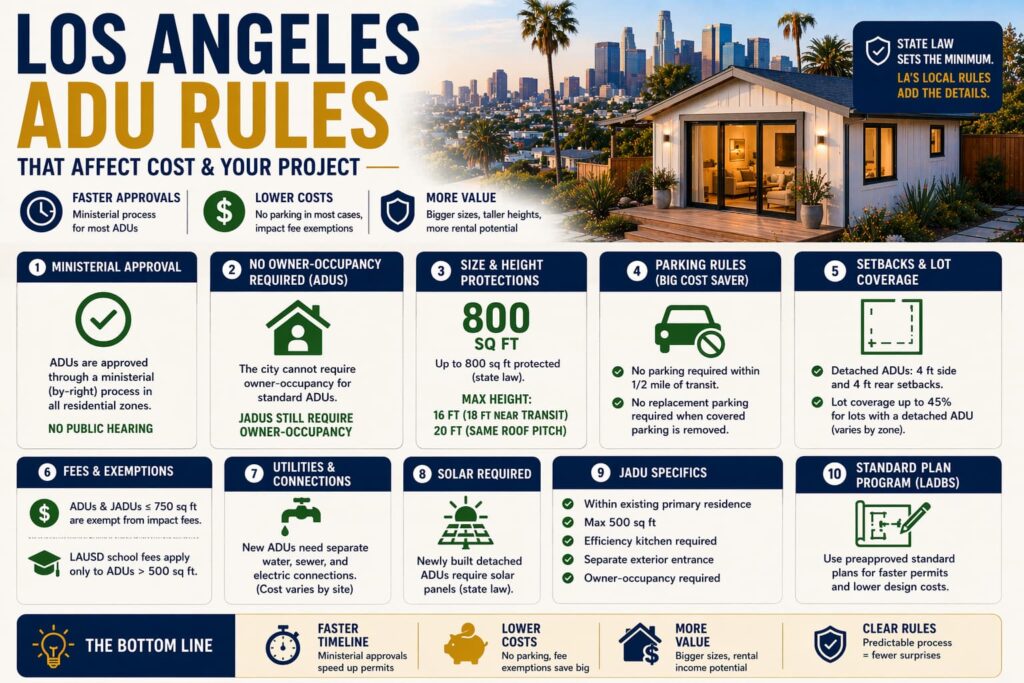
Los Angeles is not “easy” because every project is cheap. It is easier because the legal framework is clearer than in many cities.
If a homeowner only reads one official source, I would send them to Los Angeles City Planning’s current ZA Memo 143, which summarizes the city’s ADU and JADU development standards as updated through the January 1, 2025 state-law changes.
A) ADUs are ministerial in residential areas
Los Angeles City Planning states that ADUs are permitted through a ministerial process in areas zoned for single-family or multifamily residential use where there is a proposed or existing dwelling on the lot.
Why this matters for cost: ministerial approval means less discretionary review, fewer hearings, less redesign risk, and fewer soft-cost surprises.
B) Owner occupancy is no longer the standard ADU blocker in Los Angeles
Los Angeles explains in ZA Memo 143 that AB 976 permanently removed local authority to require owner occupancy for an ADU on a lot with a proposed or existing single-family dwelling.
That is a big deal for:
- long-term rental strategy
- homeowners who want flexibility in the future
- financing logic
Important exception: JADUs are still different. The memo explains that JADUs require a deed restriction documenting owner occupancy of either the primary residence or the JADU, unless the owner is a government agency, land trust, or housing organization.
C) Parking rules are much better than many homeowners assume
According to LADBS, parking is not required for new ADUs if they are within a half-mile walk of public transit. LADBS also states that if you remove covered parking to build an ADU, you do not need to replace it.
Why this matters for budget: in other cities, replacing garage parking, adding paving, or redesigning driveways can quietly add thousands.
D) The 800 sf rule is one of the biggest budget anchors in Los Angeles
ZA Memo 143 confirms the state-law path that allows one detached new-construction ADU on a lot with a proposed or existing single-family dwelling with:
- up to 800 square feet of floor area
- 4-foot side and rear setbacks
- the applicable state-law height allowance
Why this matters: in Los Angeles, 800 sf is not just a legal minimum protection. It is also one of the most important budget sweet spots in the whole market.
It is large enough to create a real one-bedroom or compact two-bedroom layout, but still small enough to stay below many of the budget escalators that hit 1,000+ sf projects.
E) Height rules can be better than people remember
ZA Memo 143 reflects the newer state-law height framework. For detached ADUs, the memo notes:
- 16 feet standard
- 18 feet if within a half-mile of transit
- plus 2 additional feet in some cases where the roof pitch aligns with the primary dwelling, allowing up to 20 feet
Why this matters: height flexibility can reduce the number of awkward design compromises, especially on tighter lots.
F) Attached ADUs can exceed the 50% rule in important ways
Los Angeles preserves the California rule that attached ADUs can go beyond the usual 50% of existing-home floor area limit up to:
- 850 square feet for a studio/one-bedroom attached ADU
- 1,000 square feet for an attached ADU with more than one bedroom
This matters because a lot of homeowners assume attached ADUs are always locked into a small percentage-based cap. In many practical Los Angeles cases, they are not.
G) Fees are better than people think, but not “cheap”
ZA Memo 143 explains that:
- ADUs and JADUs smaller than 750 sq ft are free from impact fees
- larger ADUs pay impact fees on a proportional basis
- ADUs and JADUs are exempt from park fees and the Affordable Housing Linkage Fee
- LAUSD school fees are required for ADUs larger than 500 sq ft
Why this matters: Los Angeles is one of those markets where 750 sq ft is not just a design number. It is a fee strategy.
H) LADBS standard plans are one of the most useful soft-cost shortcuts in the city
LADBS runs an ADU Standard Plan Program. LADBS says the program reduces plan-check time and leads to faster permit issuance. The city also offers at least one city-owned pre-approved plan that property owners can use free of charge, including a 1-story, 1-bedroom 455 sf option.
Why this matters: if you can make a standard plan work on your lot, Los Angeles gives you one of the best soft-cost shortcuts in the region.
I) Detached new-build ADUs built from scratch need solar
LADBS states clearly that detached ADUs built from scratch must have solar panels.
Why this matters: for detached new construction, solar is not a nice-to-have line item. It is part of the real budget.
J) Los Angeles is unusually powerful for multifamily ADU strategy
ZA Memo 143 confirms that on a lot with an existing multifamily dwelling, Los Angeles must allow:
- ADUs within existing non-livable space, up to 25% of existing units with a minimum of one, and
- up to eight detached ADUs, not exceeding the number of existing units on the lot
This is one of the most important “net-new” opportunities in the city, because it means Los Angeles is not just a backyard-cottage market. It is also a serious multifamily infill ADU market.
2) The Los Angeles ADU cost formula (the practical way to budget)
Use this formula:
Total Los Angeles ADU budget
= base all-in cost by type and size
- neighborhood labor and access factor
- site and utility risk
- hillside / overlay / historic factors where relevant
- finish package upgrades
- contingency
Step 1: Pick your ADU type
Detached is usually the most expensive common path. Garage and interior conversions are often the cheapest.
Step 2: Pick your realistic size
For Los Angeles, the most useful planning buckets are:
- 150–500 sf JADU or compact studio
- 400–500 sf garage conversion or compact studio
- 500–650 sf one-bedroom sweet spot
- 650–800 sf larger one-bedroom or compact two-bedroom
- 800–1,000 sf where budget and site support it
Each of those bands is priced properly on its own page, with a Los Angeles row on every table: 600 sq ft, 800 sq ft, 1,000 sq ft, or by bedroom count as a 1 bedroom or 2 bedroom unit.
Step 3: Stress-test the lot
Ask early:
- flat or sloped?
- easy side-yard access or tight access?
- garage in good shape or not?
- sewer close by or long utility run?
- historic, HPOZ, hillside, or other overlay?
Step 4: Hold a real contingency
My Los Angeles rule of thumb:
- straightforward conversion: 8%–10%
- standard attached or detached ADU: 10%–15%
- hillside, utility-heavy, historic, or difficult-access project: 15%–20%
3) Los Angeles ADU cost by type
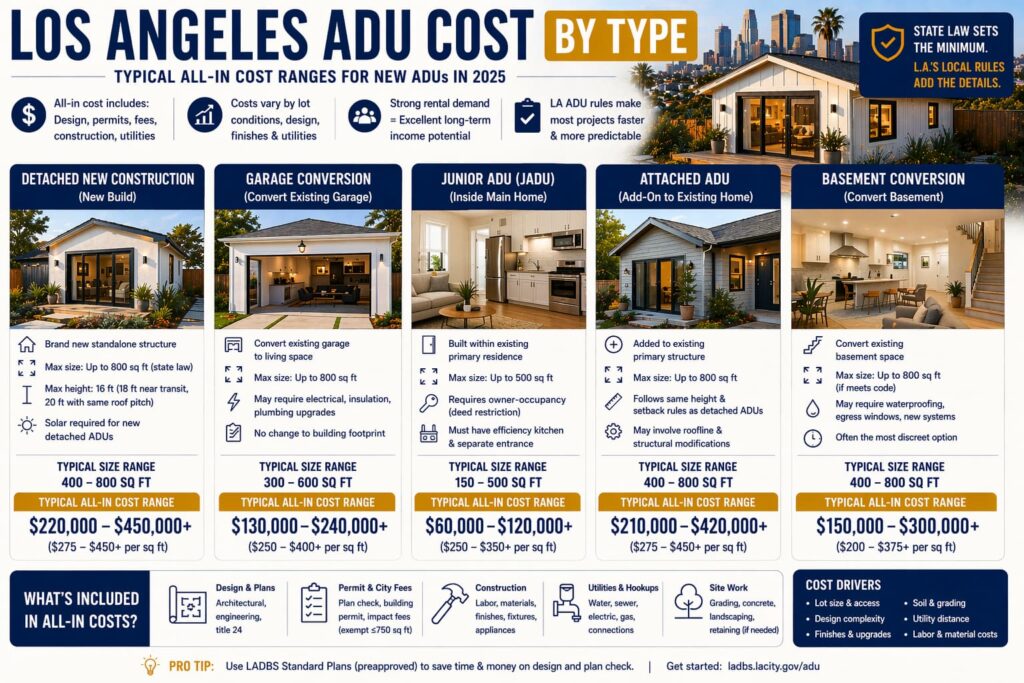
A) Detached new-build ADU
This is the classic backyard cottage, and it is still the cleanest finished product. It is also usually the most expensive common path because you are building a complete second home from scratch.
| Detached ADU size | Typical Los Angeles all-in range | Planning $/sf (all-in) |
|---|---|---|
| 500 sf | $219k–$300k | $438–$600 |
| 650 sf | $250k–$360k | $385–$554 |
| 800 sf | $300k–$459k+ | $375–$574+ |
| 1,000 sf | $360k–$550k+ | $360–$550+ |
Why detached ADUs cost more in Los Angeles
- full foundation and structure
- utility trenching and tie-ins
- solar requirement for newly built detached units
- more exposure to sitework, grading, and access limits
- more design/engineering coordination on tight lots
B) Garage conversion ADU
Garage conversions are usually the best value when the structure is sound.
| Garage conversion size | Typical Los Angeles all-in range | Planning $/sf (all-in) |
|---|---|---|
| 400 sf | $120k–$170k | $300–$425 |
| 500 sf | $140k–$200k | $280–$400 |
| 650 sf | $170k–$245k+ | $262–$377+ |
What typically drives garage conversion cost
- slab/foundation condition
- wall reframing or roof upgrades
- complete insulation/weatherization
- electrical panel capacity
- sewer distance and plumbing route
- whether the garage is truly convertible without partial rebuild
C) Basement / interior conversion ADU
This is often one of the cheapest paths where the shell already exists and headroom, moisture, and egress cooperate.
| Basement / interior size | Typical Los Angeles all-in range | Planning $/sf (all-in) |
|---|---|---|
| 450 sf | $105k–$160k | $233–$356 |
| 650 sf | $135k–$200k | $208–$308 |
| 800 sf | $170k–$230k | $213–$288 |
D) Attached ADU / addition
Attached ADUs sit in the middle. They can save on utility runs, but tie-ins to the main house can become more complex than homeowners expect.
| Attached ADU size | Typical Los Angeles all-in range | Planning $/sf (all-in) |
|---|---|---|
| 500 sf | $170k–$240k | $340–$480 |
| 650 sf | $210k–$285k | $323–$438 |
| 800 sf | $245k–$330k | $306–$413 |
E) Above-garage ADU
Above-garage ADUs are usually engineering-heavy, which is why they often cost more than people expect.
| Above-garage size | Typical Los Angeles all-in range | Planning $/sf (all-in) |
|---|---|---|
| 500 sf | $190k–$275k | $380–$550 |
| 650 sf | $230k–$350k | $354–$538 |
| 800 sf | $270k–$420k | $338–$525 |
F) Prefab / modular installed
Prefab can improve predictability and sometimes schedule, but the full installed number still includes foundation, transport, utilities, and site prep.
| Prefab / modular size | Typical Los Angeles all-in range | Planning $/sf (all-in) |
|---|---|---|
| 400 sf | $140k–$220k | $350–$550 |
| 650 sf | $190k–$290k | $292–$446 |
| 800 sf | $230k–$350k | $288–$438 |
G) JADU
JADUs are one of the most underrated LA strategies because they can solve a family-use or rental-flex problem without forcing a full detached build.
| JADU size | Typical Los Angeles all-in range | Planning $/sf (all-in) |
|---|---|---|
| 150 sf | $35k–$70k | $233–$467 |
| 300 sf | $50k–$110k | $167–$367 |
| 500 sf | $80k–$170k | $160–$340 |
4) Los Angeles ADU cost per square foot
If you want a shorthand, use this table and then adjust for site conditions.
| ADU type | Typical Los Angeles all-in $/sf |
|---|---|
| Garage conversion | $260–$425 |
| Basement / interior conversion | $208–$356 |
| Attached ADU / addition | $306–$480 |
| Detached new-build ADU | $360–$600+ |
| Above-garage ADU | $338–$550 |
| Prefab / modular installed | $288–$550 |
| JADU | $160–$467 |
Why small LA ADUs cost more per square foot
A 400 sf ADU still needs:
- a kitchen or efficiency kitchen
- a bathroom
- HVAC
- electrical and plumbing work
- permits and inspections
- utility routing
That is why a very small ADU does not cost half as much as a larger one.
5) Los Angeles neighborhood cost zones
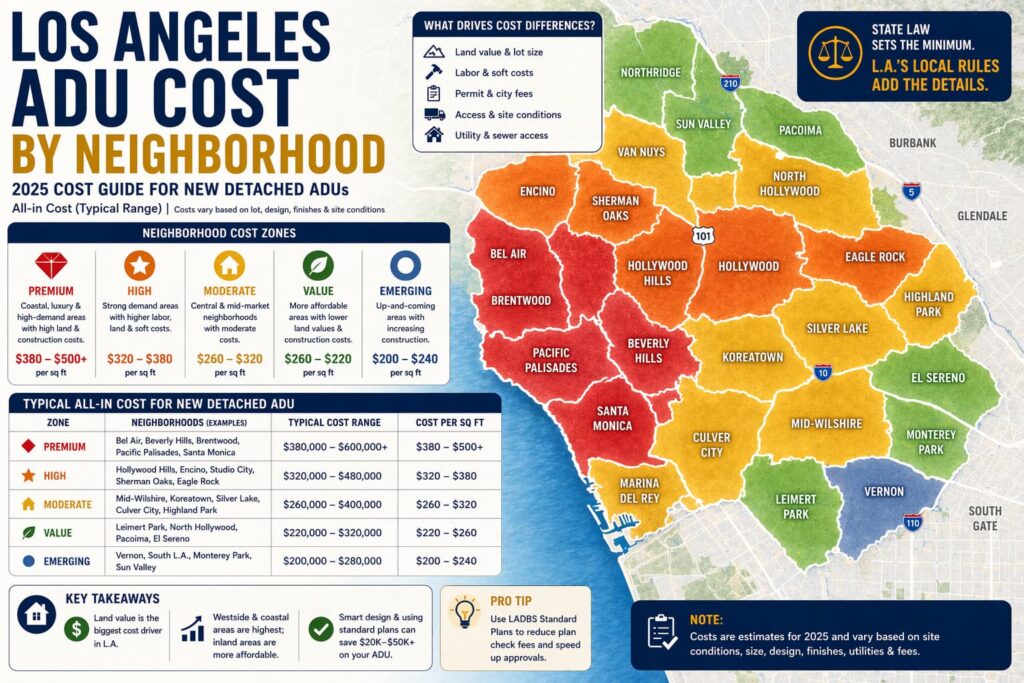
This is one of the most important pieces of net-new information for readers.
Los Angeles ADU costs do not track neighborhoods only by prestige. They track them by:
- lot access
- slope and retaining needs
- density and site constraints
- utility complexity
- finish expectations
A) Best-value ADU neighborhoods and submarkets
These are often the most practical places to build cost-efficient ADUs:
- San Fernando Valley: Van Nuys, Reseda, Northridge, Winnetka, North Hills
- Eastside suburban pockets: El Sereno, some parts of Highland Park with workable lots
- South LA and Harbor-area neighborhoods where lots are wider and flatter
- Westchester / some South Bay-adjacent submarkets where detached lots are still physically usable
Why these areas are practical
- flatter lots
- easier access
- stronger garage-conversion potential
- wider side yards and more buildable backyard area
B) Mid-tier, strong-demand neighborhoods
These are not “cheap,” but they can still be practical:
- Sherman Oaks / Studio City / Encino
- West Adams / Mid-City
- Glassell Park / Eagle Rock
- Mar Vista / Palms / some West LA submarkets where lot size supports detached units
Why they cost more
- stronger finish expectations
- tighter contractor availability
- more site constraints than typical Valley lots
C) Highest-risk / most expensive ADU neighborhoods
These neighborhoods are where ADU budgets swing hardest:
- Hollywood Hills / Studio City hillsides / Mount Washington / Silver Lake hillside pockets
- Pacific Palisades / Brentwood hillsides / Bel Air-adjacent sites
- dense core areas with tight access and alley/service complications
- historic or HPOZ-sensitive neighborhoods where design fit matters more
Why they cost more
- slope and retaining walls
- difficult staging and access
- tighter lots
- premium design expectations
- more engineering and site coordination
The practical neighborhood insight
The cheapest Los Angeles ADU is often not in the cheapest neighborhood. It is on the simplest lot in a workable neighborhood.
That is why a straightforward Valley garage conversion can beat a theoretically higher-rent hillside detached unit on pure project economics.
6) Los Angeles soft-cost accelerators most homeowners overlook
This is where readers can save real money.
A) The 455 sf city-owned standard plan is a real soft-cost shortcut
LADBS offers a city-owned 455 sf, 1-bedroom approved standard plan. If that size works for the property and use case, it can materially reduce soft-cost friction.
B) The 750 sf threshold is one of the best fee strategies in the city
In Los Angeles, 750 sf and under is not just a manageable design size. It is one of the best fee strategies because of impact-fee treatment.
C) If your site can use a standard plan, it can move faster
LADBS says the Standard Plan Program reduces plan-check time and can produce faster permit issuance.
D) Conversions can be dramatically better than detached builds when the structure cooperates
This sounds obvious, but the market still underestimates it.
A simple conversion can save homeowners:
- structural cost
- foundation cost
- detached utility trenching
- solar cost on detached new construction
7) Los Angeles hidden costs that blow up budgets
These are the line items that most often turn a “reasonable” ADU into a surprise project.
| Hidden cost item | When it appears | Typical planning impact |
|---|---|---|
| Utility service upgrade | existing electrical or water service is undersized | $3k–$15k+ |
| Sewer connection or line changes | existing line inadequate or route is difficult | $5k–$25k+ |
| Long trenching to detached ADU | backyard siting far from utilities | $5k–$20k+ |
| Slope / retaining walls | hillside or grade problems | $15k–$100k+ |
| Difficult site access / crane logistics | tight urban or steep lots | $5k–$30k+ |
| Garage structural correction | older garage not truly conversion-ready | $10k–$40k+ |
| Historic or overlay review complications | HPOZs or sensitive neighborhoods | time + redesign + fees |
| Solar on new detached ADUs | new detached construction | $8k–$20k+ |
| LAUSD school fees | ADUs larger than 500 sf | varies by project |
The Los Angeles-specific budget truth
In Los Angeles, homeowners most often underestimate:
- utility routing for detached ADUs
- how expensive hillsides become
- how much easier simple garage conversions can be
- the value of standard plans and right-sized units
8) Los Angeles ADU cost by lot profile
A) Simple lot
Flat, normal access, short utility runs, no major overlay or hillside complications.
| Project type | Typical all-in on a simple LA lot |
|---|---|
| Conversion ADU | $110k–$190k |
| Attached ADU | $175k–$290k |
| Detached ADU | $220k–$350k |
B) Moderate lot
Longer trenching, tighter access, some drainage, some design coordination.
| Project type | Typical all-in on a moderate LA lot |
|---|---|
| Conversion ADU | $130k–$220k |
| Attached ADU | $200k–$320k |
| Detached ADU | $270k–$430k |
C) Difficult lot
Hillside, retaining walls, major utility work, historic overlay, or difficult staging.
| Project type | Typical all-in on a difficult LA lot |
|---|---|
| Conversion ADU | $150k–$260k+ |
| Attached ADU | $230k–$380k+ |
| Detached ADU | $340k–$600k+ |
9) Los Angeles fee strategy and smart sizing
This is the section most generic articles miss.
A) Why 750 sq ft matters so much in LA
Because of impact-fee treatment, 750 sq ft is one of the most important cost thresholds in the whole city.
B) Why 800 sq ft matters too
Because state law protects that size in the core detached-ADU path, 800 sq ft is one of the most important entitlement thresholds in the city.
C) The sweet spot most homeowners should think about first
For a lot of LA homeowners, the most practical sizing strategy is:
- 455 sf standard plan if the goal is cost control and speed
- 500–650 sf if the goal is a true one-bedroom with manageable cost
- 750–800 sf if the goal is maximum livability before the project starts feeling materially heavier
That is a more useful planning framework than asking for one average citywide number.
10) Three Los Angeles sample budgets that feel real
Example A: 500 sf garage conversion in Van Nuys
| Budget category | Planning range |
|---|---|
| Design + engineering | $8,000–$16,000 |
| Permits + fees | $4,000–$12,000 |
| Structure/slab/framing fixes | $12,000–$28,000 |
| Plumbing + electrical + HVAC | $28,000–$55,000 |
| Insulation, drywall, finishes | $35,000–$60,000 |
| Utility/sitework | $5,000–$12,000 |
| Contingency | $10,000–$18,000 |
| Total | $102,000–$201,000 |
Example B: 650 sf detached ADU in Westchester on a typical lot
| Budget category | Planning range |
|---|---|
| Design + engineering | $12,000–$24,000 |
| Permits + fees | $8,000–$22,000 |
| Foundation + sitework | $22,000–$50,000 |
| Framing + shell + windows/doors | $70,000–$130,000 |
| MEP | $36,000–$68,000 |
| Interior finishes | $36,000–$68,000 |
| Solar | $8,000–$18,000 |
| Contingency | $18,000–$32,000 |
| Total | $210,000–$412,000 |
Example C: 800 sf detached ADU on a hillside lot in Mount Washington
| Budget category | Planning range |
|---|---|
| Design + engineering | $18,000–$40,000 |
| Permits + fees | $10,000–$30,000 |
| Sitework, utilities, drainage, retaining | $40,000–$130,000 |
| Foundation + envelope | $95,000–$180,000 |
| MEP | $45,000–$85,000 |
| Interior finishes | $40,000–$85,000 |
| Solar | $10,000–$20,000 |
| Contingency | $25,000–$45,000 |
| Total | $283,000–$615,000+ |
11) Natural government resource links readers will actually use
When readers want to verify a Los Angeles ADU rule themselves, these are the official resources worth using naturally inside the article:
- Los Angeles City Planning’s ZA Memo 143
- LADBS’s ADU page
- LADBS’s ADU Standard Plan Program
- California HCD’s ADU page
- California HCD’s current ADU Handbook
- Los Angeles Housing Department’s ADU page
- LA’s ADU Accelerator Program if readers want the city’s older-adult affordable-rental pairing concept
12) How to lower your Los Angeles ADU cost without regretting it
| Cost lever | What to do | Why it saves money |
|---|---|---|
| Place the ADU near utilities | Shorter trenching and easier tie-ins | Utilities are one of the biggest LA wildcards |
| Keep the footprint simple | Rectangle or simple form | Less foundation and framing complexity |
| Choose the right type for the lot | Sometimes conversion beats detached by a lot | Existing shell can save tens of thousands |
| Stay at or under strategic size thresholds | Especially 750–800 sf | Can materially improve project economics |
| Use a standard plan when the site fits | Reduce soft costs and review friction | Best soft-cost shortcut in the city |
| Avoid hillside complexity unless the economics truly justify it | Hillsides punish budgets fast | This is often the single biggest cost mistake |
My biggest Los Angeles advice
Do not ask only, “What does an ADU cost in Los Angeles?”
Ask instead:
- What does this type cost in this neighborhood on this lot under this fee and review path?
That is where the real number lives.
13) FAQs about Los Angeles ADU costs
Are ADUs legal in the City of Los Angeles?
Yes. Los Angeles has one of the strongest and clearest ADU pathways in the country.
Does Los Angeles still require owner occupancy for ADUs?
Not for standard ADUs. JADUs are different and still carry owner-occupancy-related deed-restriction requirements.
Does Los Angeles require parking for an ADU?
Often no, especially within a half-mile walk of public transit, and replacement parking is not required when covered parking is removed in conjunction with the ADU.
Are detached ADUs in Los Angeles required to have solar?
Yes, if they are built from scratch as new detached ADUs.
What is the cheapest type of ADU in Los Angeles?
Usually a JADU, interior conversion, or garage conversion, if the existing space and utility routes cooperate.
What is the most expensive common type?
Usually a detached new-build ADU on a hillside or constrained lot.
What is the most important size threshold to know?
Both 750 sq ft and 800 sq ft. One matters heavily for fees, and the other matters heavily for entitlement protection.
Final takeaway
Los Angeles is one of the best ADU cities in the country, but it is not a one-number market.
The budget still lives or dies on the same five things:
- neighborhood
- ADU type
- size
- lot difficulty
- utility and review reality
That is especially true in Los Angeles because the difference between a flat, garage-ready Valley lot and a constrained hillside lot can be enormous.
If you want a Los Angeles ADU number you can actually trust, do not stop at the citywide average.
Get specific about the neighborhood, type, size, and lot