
How Much Does an ADU Cost in Oregon in 2026?
Planning-level pricing guide by ADUWizard.com
Updated for 2026 budgeting
Oregon is one of the most important ADU states in the country. The state has spent years removing barriers to infill housing, and that matters because ADU pricing is not just about labor and lumber. It is also about whether your city allows the project at all, whether parking rules inflate costs, whether owner-occupancy blocks financing, and whether local standards are simple enough to keep the design process moving.
This guide is the statewide version of our city-level ADU cost articles. It is built to answer the practical question homeowners actually ask:
How much does an ADU cost in Oregon, and which Oregon cities make the most sense right now?
We will cover the real numbers by type, size, region, and city, and then show where Oregon’s growing cities are creating the strongest ADU demand.
Important disclaimer: This is a planning guide, not a quote and not legal advice. Actual bids vary by city, zoning, lot size, slope, tree constraints, sewer/septic setup, utility upgrades, finish package, and contractor availability. Use these ranges to budget and to compare bids apples-to-apples.
Oregon ADU cost in 2026 (quick answer)
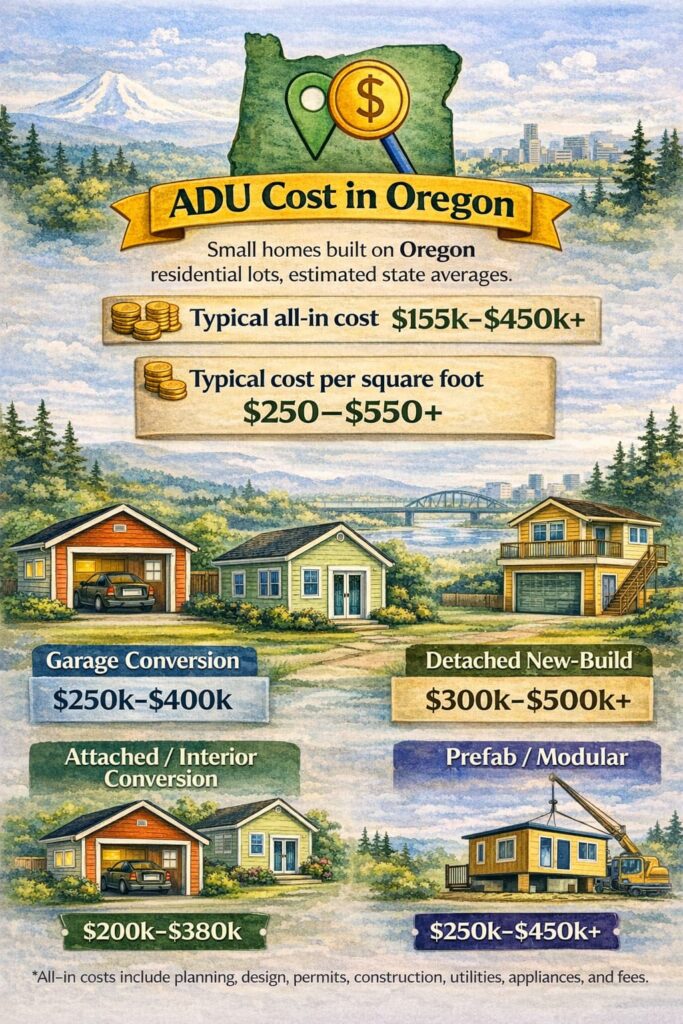
For most Oregon homeowners, a realistic all-in ADU budget is usually in the mid-six figures to low/mid $400Ks, depending on location and type.
Typical all-in Oregon ADU cost ranges (2026)
| Project scenario | Typical size | Typical Oregon all-in cost |
|---|---|---|
| Garage conversion ADU | 400–700 sf | $110k–$240k |
| Basement / interior conversion | 450–800 sf | $100k–$230k |
| Attached ADU / addition | 500–800 sf | $160k–$320k |
| Detached new-build ADU | 500–800 sf | $210k–$430k |
| Above-garage ADU | 500–800 sf | $210k–$390k |
| Prefab / modular installed | 400–800 sf | $170k–$340k |
What “all-in” means in this guide
When I say all-in, I mean a planning budget that usually includes:
- design and drafting
- structural engineering and common consultants
- permits and typical local fees
- construction labor and materials
- contractor overhead and profit
- a reasonable contingency
What it may not fully include:
- unusual SDCs or city utility fees
- major retaining walls or slope work
- extraordinary tree mitigation
- large septic system upgrades
- premium architectural finishes
1) Oregon ADU rules that directly affect cost
Oregon’s statewide rules are a big reason ADUs are more viable here than in many other states.
A) Oregon requires many cities to allow ADUs in detached housing zones
Oregon law requires, and Oregon’s own ADU guidance from the Department of Land Conservation and Development walks through the rule in plain English:
- cities with a population of over 2,500, and
- counties with a population of over 15,000 within urban growth boundaries
to allow at least one ADU in areas zoned for detached single-family housing.
Why this matters for cost: the project starts from a stronger legal baseline. When a state forces ADUs into the code, it removes a lot of the expensive “Can I even do this?” uncertainty that still exists in less ADU-friendly states.
B) Oregon does not allow local governments to require off-street parking or owner occupancy for ADUs
This is one of the most important cost-saving rules in the state.
Why it matters:
- parking pads, driveway changes, and site paving can quietly add thousands
- owner-occupancy rules can limit financing flexibility and long-term use
There is an exception for ADUs used as vacation rentals, where some parking or owner-occupancy restrictions may still appear.
C) Oregon treats attached, interior, and detached ADUs as legitimate paths
Under the state framework, an ADU can be:
- interior
- attached
- detached
That matters because the cheapest ADU for a site is often not the detached cottage people imagine first. On many Oregon properties, the smartest move is a garage conversion, a basement conversion, or an attached addition.
D) Local standards must be clear and objective inside UGBs
Oregon housing law limits cities and counties to clear and objective standards for housing development in urban growth boundaries. The state’s Goal 10 housing resources page is a useful starting point if you want to understand the broader framework behind that approach.
Why it matters: vague rules about “compatibility” and “character” tend to create extra design work, redesigns, delay, and cost.
E) Separate sewer and water requirements can still be a major cost variable
Oregon’s own ADU guidance specifically warns that local rules requiring separate sewer and water connections can create barriers because they can be prohibitively expensive. That is one of the reasons I always tell homeowners to verify utility assumptions early, especially outside the biggest metro areas.
F) Prefab and modular housing matter in Oregon too
Oregon law also protects prefabricated and manufactured housing from being treated more restrictively than site-built housing in residential zones. That does not make prefab magically cheap, but it makes it a more realistic statewide option.
2) The Oregon ADU cost formula (the fast way to budget)
Use this formula:
Total Oregon ADU budget
= base all-in cost by type and size
- regional labor and fee factor
- site and utility risk
- finish package upgrades
- contingency
Step 1: Choose your region
Labor, permit culture, and utility conditions vary more across Oregon than many people expect.
Step 2: Choose your ADU type
Detached is usually the most expensive common path. Interior and conversion options are often the cheapest.
Step 3: Choose your realistic size
In Oregon, the best planning buckets are:
- 350–500 sf studio or compact 1-bed
- 500–650 sf 1-bed sweet spot
- 650–800 sf larger 1-bed or compact 2-bed
- 800–900 sf when local standards and site conditions support it
Step 4: Stress-test the lot
Is it:
- flat or sloped?
- on sewer or septic?
- close to utilities or far from them?
- constrained by trees, overlays, or access?
Step 5: Hold a real contingency
My Oregon rule of thumb:
- straightforward conversion: 8%–10%
- attached or detached new-build: 10%–15%
- septic, slope, tree, or utility uncertainty: 15%–20%
3) Oregon ADU cost by type
A) Detached new-build ADU
This is the classic backyard cottage. It is usually the cleanest finished product and one of the strongest long-term assets, but it is also typically the most expensive common path.
| Detached ADU size | Typical Oregon all-in range | Planning $/sf (all-in) |
|---|---|---|
| 500 sf | $180k–$290k | $360–$580 |
| 650 sf | $215k–$355k | $331–$546 |
| 800 sf | $250k–$430k | $313–$538 |
B) Garage conversion ADU
Garage conversions can be the best value when the existing structure is solid and the utility route is short.
| Garage conversion size | Typical Oregon all-in range | Planning $/sf (all-in) |
|---|---|---|
| 400 sf | $95k–$150k | $238–$375 |
| 500 sf | $110k–$180k | $220–$360 |
| 650 sf | $140k–$240k | $215–$369 |
C) Basement / interior conversion ADU
This is often the cheapest path where the shell already exists and headroom / moisture / egress cooperate.
| Basement / interior size | Typical Oregon all-in range | Planning $/sf (all-in) |
|---|---|---|
| 450 sf | $90k–$145k | $200–$322 |
| 650 sf | $120k–$185k | $185–$285 |
| 800 sf | $145k–$230k | $181–$288 |
D) Attached ADU / addition
Attached ADUs sit in the middle. They often save on utility runs compared to detached units, but structural tie-ins can add complexity.
| Attached ADU size | Typical Oregon all-in range | Planning $/sf (all-in) |
|---|---|---|
| 500 sf | $145k–$225k | $290–$450 |
| 650 sf | $175k–$275k | $269–$423 |
| 800 sf | $205k–$320k | $256–$400 |
E) Above-garage ADU
These often look efficient conceptually, but they are usually engineering-heavy.
| Above-garage size | Typical Oregon all-in range | Planning $/sf (all-in) |
|---|---|---|
| 500 sf | $170k–$265k | $340–$530 |
| 650 sf | $200k–$325k | $308–$500 |
| 800 sf | $230k–$390k | $288–$488 |
F) Prefab / modular installed
Prefab can improve predictability and sometimes schedule, but the full installed cost still includes foundations, delivery, utility hookups, and finishing.
| Prefab / modular size | Typical Oregon all-in range | Planning $/sf (all-in) |
|---|---|---|
| 400 sf | $130k–$210k | $325–$525 |
| 650 sf | $170k–$270k | $262–$415 |
| 800 sf | $200k–$340k | $250–$425 |
4) Oregon ADU cost per square foot
If you want a simple shorthand, use this table and then adjust for site conditions.
| ADU type | Typical Oregon all-in $/sf |
|---|---|
| Garage conversion | $220–$360 |
| Basement / interior conversion | $180–$320 |
| Attached ADU / addition | $250–$430 |
| Detached new-build ADU | $310–$550+ |
| Above-garage ADU | $290–$560 |
| Prefab / modular installed | $250–$450 |
Why small ADUs cost more per square foot
A 400 sf ADU still needs:
- a kitchen
- a bathroom
- HVAC
- permits and inspections
- electrical/plumbing decisions
- utility routing
That is why small ADUs often cost much more per sf than a 650–800 sf unit.
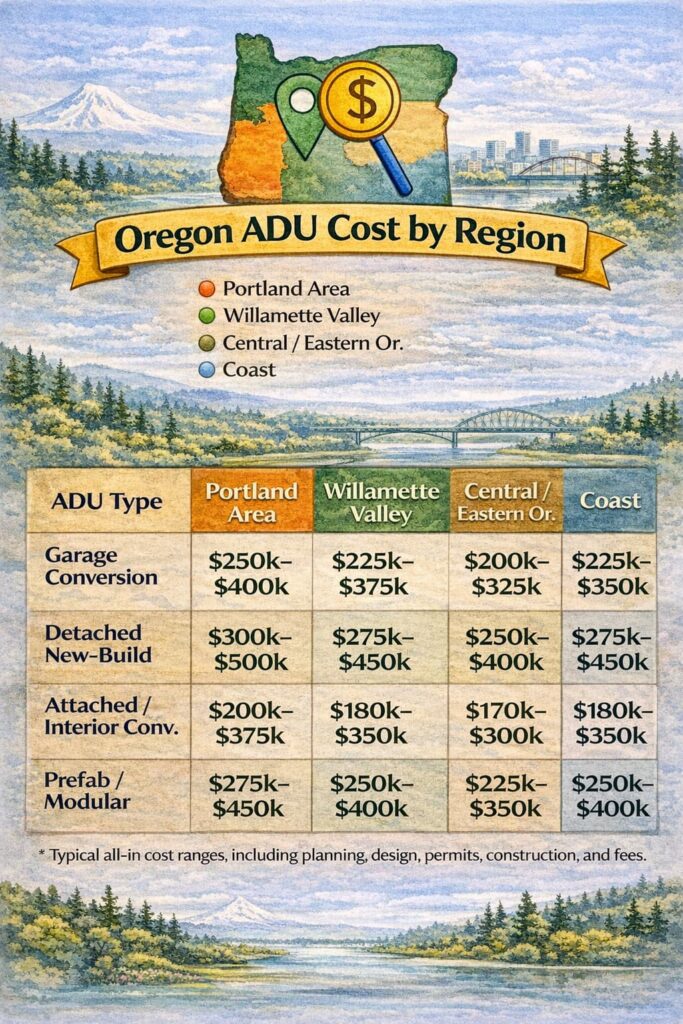
5) Oregon ADU cost by region
A) Portland Metro (Portland, Beaverton, Hillsboro, Tigard, Lake Oswego, Happy Valley, Wilsonville)
This is the largest and most active ADU region in the state. Labor is relatively expensive, but strong demand and mature infill codes make the market deep.
| Project type | Typical all-in range in Portland Metro |
|---|---|
| Conversion ADU | $120k–$230k |
| Attached ADU | $170k–$320k |
| Detached ADU | $220k–$450k |
B) Eugene / Springfield / Lane County corridor
This region tends to price below Portland Metro but above many smaller markets because of contractor demand and university-driven housing pressure.
| Project type | Typical all-in range in Eugene / Springfield |
|---|---|
| Conversion ADU | $110k–$210k |
| Attached ADU | $160k–$295k |
| Detached ADU | $210k–$390k |
C) Salem / Keizer / Mid-Willamette Valley
Salem is often one of the better “value” ADU markets in Oregon: strong housing need, large suburban housing stock, and typically somewhat lower pricing than Portland.
| Project type | Typical all-in range in Salem / Keizer |
|---|---|
| Conversion ADU | $105k–$205k |
| Attached ADU | $155k–$285k |
| Detached ADU | $200k–$365k |
D) Bend / Redmond / Central Oregon
Central Oregon has some of the strongest long-term housing demand in the state, but labor and finish expectations can push pricing up fast.
| Project type | Typical all-in range in Bend / Redmond |
|---|---|
| Conversion ADU | $120k–$225k |
| Attached ADU | $170k–$315k |
| Detached ADU | $230k–$470k |
E) Corvallis / Albany / Linn-Benton area
A strong college-and-healthcare market with steady housing demand and relatively stable budgeting compared with Portland Metro.
| Project type | Typical all-in range in Corvallis / Albany |
|---|---|
| Conversion ADU | $110k–$210k |
| Attached ADU | $160k–$295k |
| Detached ADU | $210k–$390k |
F) Medford / Ashland / Grants Pass / Southern Oregon
Southern Oregon can still pencil well, but hillside sites, wildfire design considerations, and local contractor availability can widen bids.
| Project type | Typical all-in range in Southern Oregon |
|---|---|
| Conversion ADU | $100k–$205k |
| Attached ADU | $150k–$280k |
| Detached ADU | $195k–$360k |
G) Coast and smaller destination towns
Coastal and destination markets are a separate animal. Logistics, weather exposure, hazard overlays, and a smaller contractor pool can push costs up.
| Project type | Typical all-in range in coastal / destination markets |
|---|---|
| Conversion ADU | $120k–$240k |
| Attached ADU | $175k–$325k |
| Detached ADU | $230k–$430k |
6) Oregon’s growing cities: where ADU demand is strongest right now
If I were choosing Oregon markets to watch for ADU demand, I would focus on growth plus housing pressure, not just raw population size.
1) Hillsboro
Hillsboro is one of the strongest ADU-demand cities in Oregon because it sits in a fast-growing Washington County market with persistent housing pressure and a huge employment base.
Why it matters for ADUs:
- large suburban single-family housing stock
- strong family demand
- more homeowners with lots that can physically support ADUs
2) Beaverton
Beaverton has crossed the 100,000 mark and remains one of the state’s clearest examples of suburban growth. The Oregon Secretary of State’s city population page, which uses Portland State’s population research, is a good reference point for the statewide growth picture behind this trend.
Why it matters for ADUs:
- strong demand for family housing and multigenerational living
- rising land values make backyard infill more attractive
- close-in metro demand with slightly different lot economics than Portland itself
3) Happy Valley
Happy Valley is still one of Oregon’s strongest growth stories in percentage terms over the longer period.
Why it matters for ADUs:
- large-lot suburban housing stock
- multigenerational use cases are strong
- good market for family-use ADUs and future flexibility
4) Wilsonville
Wilsonville continues to look attractive because it blends job access, suburban housing stock, and relatively high-value owner-occupied homes.
Why it matters for ADUs:
- lots are often more physically workable than in dense inner-city neighborhoods
- higher property values make ADU economics more tolerable
5) Bend
Bend is no secret. It remains one of Oregon’s strongest high-demand housing markets, which is exactly why ADUs stay interesting there even when construction costs are not cheap.
Why it matters for ADUs:
- sustained housing pressure
- strong rental and family-use demand
- owners are often willing to spend more on design and finish quality
6) Redmond
Redmond is one of the most important secondary ADU markets in Oregon because it combines growth with a somewhat more forgiving price point than Bend.
Why it matters for ADUs:
- continued in-migration to Central Oregon
- suburban housing stock that often fits detached or garage-conversion projects well
- good value angle for homeowners who cannot make Bend numbers work
7) Salem / Keizer
These are not always the “hottest” cities in headlines, but they are some of the most practical ADU markets in the state.
Why they matter for ADUs:
- deep owner-occupied housing stock
- strong need for family flex housing
- often better cost-value balance than Portland or Bend
8) Eugene / Springfield
Eugene and Springfield remain attractive for ADUs because of university demand, general housing pressure, and a broad mix of lot sizes and older housing stock.
Why they matter for ADUs:
- conversions can work well in older housing stock
- demand is diversified between family use and long-term rental logic
9) Corvallis / Albany
This corridor is not always dramatic in headlines, but it can be one of the best steady ADU markets in Oregon.
Why it matters:
- education and healthcare anchor demand
- smaller-scale markets can still support strong ADU use cases
10) Medford / Ashland / Grants Pass
Southern Oregon remains a real ADU market, especially where homeowners need flexible living arrangements or long-term rental income.
Why it matters:
- aging-in-place and family-use demand is strong
- some lots are easier to work with than in denser metro neighborhoods
7) Oregon city-by-city ADU cost snapshots
These are planning-level numbers for the cities homeowners most often ask about.
| City / market | Detached ADU (typical all-in) | Conversion ADU (typical all-in) | What usually drives cost |
|---|---|---|---|
| Portland | $220k–$430k | $110k–$220k | fees, SDCs, utilities, tree/site constraints |
| Beaverton | $230k–$440k | $120k–$225k | metro labor, suburban demand, utility work |
| Hillsboro | $230k–$450k | $120k–$230k | high demand, metro labor, lot utilization |
| Happy Valley | $240k–$460k | $125k–$235k | larger homes/lots, slope in some areas |
| Wilsonville | $235k–$445k | $120k–$230k | higher-value suburban builds |
| Salem | $200k–$360k | $105k–$200k | better value labor market, strong family-use cases |
| Keizer | $195k–$350k | $100k–$195k | similar to Salem with slightly softer pricing |
| Eugene | $215k–$390k | $110k–$210k | steady demand, older stock, labor pressure |
| Springfield | $205k–$375k | $105k–$205k | slightly lower than Eugene on many projects |
| Bend | $240k–$470k | $120k–$225k | labor cost, finish expectations, demand |
| Redmond | $220k–$420k | $115k–$215k | growth market with slightly better value than Bend |
| Corvallis | $215k–$390k | $110k–$210k | college/healthcare demand, steady pricing |
| Albany | $205k–$370k | $105k–$205k | good value alternative to Corvallis |
| Medford | $195k–$350k | $100k–$195k | utility/site conditions, contractor availability |
| Ashland | $220k–$420k | $115k–$220k | design expectations, hillside sites, premiums |
| Grants Pass | $190k–$340k | $100k–$190k | simpler lots can pencil well |
8) Hidden costs that blow up Oregon ADU budgets
These are the line items that most often turn a “reasonable” ADU into a surprise project.
| Hidden cost item | When it appears | Typical planning impact |
|---|---|---|
| System development charges (SDCs) | city-specific fee structures | $5k–$25k+ |
| Water meter upsizing / utility service work | existing service too small | $2k–$12k+ |
| Sewer connection changes | line inadequacy or long route | $5k–$25k+ |
| Long trenching to detached ADU | backyard siting far from utilities | $5k–$20k+ |
| Stormwater / drainage work | new impervious area or slope | $3k–$20k+ |
| Tree protection / removal | lots with significant trees or overlays | $2k–$20k+ |
| Retaining walls / slope work | hillside or grade issues | $15k–$80k+ |
| Septic system upgrades | rural or fringe properties | $10k–$40k+ |
| Historic or design review complications | older neighborhoods / overlays | time + redesign + fees |
The Oregon-specific budget truth
In Oregon, homeowners most often underestimate:
- local fees and SDCs
- sewer and water realities
- site slope and drainage
- how expensive detached utility trenching can be
9) Oregon ADU cost by lot profile
A) Simple lot
Flat, normal access, short utility runs, no big tree or septic issues.
| Project type | Typical all-in on a simple lot |
|---|---|
| Conversion ADU | $100k–$190k |
| Attached ADU | $150k–$280k |
| Detached ADU | $210k–$330k |
B) Moderate lot
Longer trenching, limited access, some drainage, maybe tighter setbacks or a more complicated site.
| Project type | Typical all-in on a moderate lot |
|---|---|
| Conversion ADU | $115k–$215k |
| Attached ADU | $170k–$310k |
| Detached ADU | $240k–$395k |
C) Difficult lot
Slope, retaining walls, major utility work, tree constraints, septic issues, or meaningful overlay complications.
| Project type | Typical all-in on a difficult lot |
|---|---|
| Conversion ADU | $135k–$250k+ |
| Attached ADU | $200k–$350k+ |
| Detached ADU | $300k–$500k+ |
10) Finish level: what design choices do to the Oregon budget
| Finish level | Typical impact | Example on a $280k detached ADU |
|---|---|---|
| Value / builder-grade | baseline | $280k |
| Mid-range | +5% to +15% | $294k–$322k |
| High-end / custom | +15% to +35%+ | $322k–$378k+ |
The upgrades that move the budget fastest
| Upgrade | Typical adder | Why it matters |
|---|---|---|
| Premium kitchen package | +$8k–$35k+ | Cabinetry and appliances scale quickly |
| Second bathroom | +$12k–$30k | More MEP and finish work |
| Large custom windows/doors | +$5k–$25k+ | Product + structure + labor |
| High-end exterior cladding | +$5k–$20k+ | Material and detailing cost |
| Deck / stairs / covered patio | +$5k–$30k+ | Structure, rails, waterproofing |
| Upgraded HVAC / comfort package | +$5k–$20k | Better efficiency and controls |
11) Three statewide Oregon sample budgets that feel real
Example A: 500 sf garage conversion in Salem
| Budget category | Planning range |
|---|---|
| Design + engineering | $8,000–$16,000 |
| Permits + fees | $4,000–$12,000 |
| Structure/slab/framing fixes | $12,000–$30,000 |
| Plumbing + electrical + HVAC | $28,000–$55,000 |
| Insulation, drywall, finishes | $35,000–$60,000 |
| Utility/sitework | $5,000–$12,000 |
| Contingency | $10,000–$18,000 |
| Total | $102,000–$203,000 |
Example B: 650 sf detached ADU in Eugene on a typical lot
| Budget category | Planning range |
|---|---|
| Design + engineering | $12,000–$24,000 |
| Permits + fees | $8,000–$22,000 |
| Foundation + sitework | $22,000–$50,000 |
| Framing + shell + windows/doors | $68,000–$125,000 |
| MEP | $34,000–$65,000 |
| Interior finishes | $34,000–$65,000 |
| Contingency | $16,000–$30,000 |
| Total | $194,000–$381,000 |
Example C: 800 sf detached ADU in Bend on a tougher lot
| Budget category | Planning range |
|---|---|
| Design + engineering | $18,000–$35,000 |
| Permits + fees | $10,000–$28,000 |
| Sitework, utilities, drainage, retaining | $35,000–$100,000 |
| Foundation + envelope | $85,000–$155,000 |
| MEP | $40,000–$75,000 |
| Interior finishes | $38,000–$75,000 |
| Contingency | $22,000–$40,000 |
| Total | $248,000–$508,000+ |
12) How to lower your Oregon ADU cost without regretting it
| Cost lever | What to do | Why it saves money |
|---|---|---|
| Place the ADU near utilities | Shorter trenching and easier tie-ins | Utilities are one of the biggest wildcards statewide |
| Keep the footprint simple | Rectangle or simple form | Less foundation and framing complexity |
| Choose the right type for the site | Sometimes conversion beats detached by a lot | Existing shell can save tens of thousands |
| Lock finish allowances early | Make bids comparable | Reduces change orders and scope drift |
| Avoid over-designing small units | Do not force luxury detailing into a tiny footprint | Small units already carry high fixed-cost intensity |
| Stress-test septic and drainage early | Especially outside major metros | These can be true budget killers |
My biggest statewide Oregon advice
Do not ask only, “What does an ADU cost in Oregon?”
Ask instead:
- What does this type cost in this city on this lot?
That is where the real number lives.
13) FAQs about Oregon ADU costs
Are ADUs legal in Oregon?
Yes, widely. Oregon requires many cities and counties above population thresholds to allow at least one ADU in zones for detached single-family housing inside urban growth boundaries.
Does Oregon allow cities to require parking for ADUs?
Not generally. Oregon law does not allow local governments to require off-street parking for ADUs, except in certain vacation-rental situations.
What is the cheapest type of ADU in Oregon?
Usually a basement/interior conversion or a garage conversion, if the existing structure and utility routes cooperate.
What is the most expensive common type?
Usually a detached new-build ADU.
Which Oregon cities are strongest for ADU demand right now?
Portland Metro suburbs like Hillsboro, Beaverton, Happy Valley, and Wilsonville, plus Bend, Redmond, Salem, Eugene/Springfield, and some Southern Oregon markets.
Can prefab be a good option in Oregon?
Yes, especially where schedule and predictability matter, but the full cost still includes foundations, delivery, utility hookups, and site prep.
Final takeaway
Oregon is one of the best states in the country for ADUs because the legal baseline is stronger than in most states. But the budget still lives or dies on the same five things:
- region
- ADU type
- size
- lot difficulty
- utility reality
The fastest-growing Oregon cities are the ones where this matters most, because housing pressure pushes more homeowners to ask whether a backyard unit, conversion, or family-use ADU finally makes sense.
If you want an Oregon ADU number you can actually trust, do not stop at the statewide average.
Get specific about the city, type, size, and lot.
ADU cost by size
Same cost engine, priced by size rather than by place. Each page carries a per-city table, so you can read the Oregon numbers at the size you are actually planning.
Cities in Oregon
City-level ADU cost and permit-timeline breakdowns within Oregon.