
California is still the most important ADU market in the country.
That does not mean there is one California ADU price.
A detached ADU in Los Angeles is not the same project as a garage conversion in Fresno. A backyard cottage in San Jose is not the same as a basement unit in Oakland. A simple suburban lot in Sacramento is not the same as a hillside lot in the Bay Area or a coastal property in San Diego.
That is why this guide goes deeper than a generic statewide average.
This is the California master article built the same way we approach our most detailed state guides. It answers the practical question homeowners actually ask:
How much does an ADU cost in California, and how do costs change by type, size, city, region, and lot conditions?
We will cover the real numbers by type, size, region, and city, then show which California markets are the most practical, which ones are the most expensive, and where homeowners can still create a strong ADU project without Bay Area-level pricing.
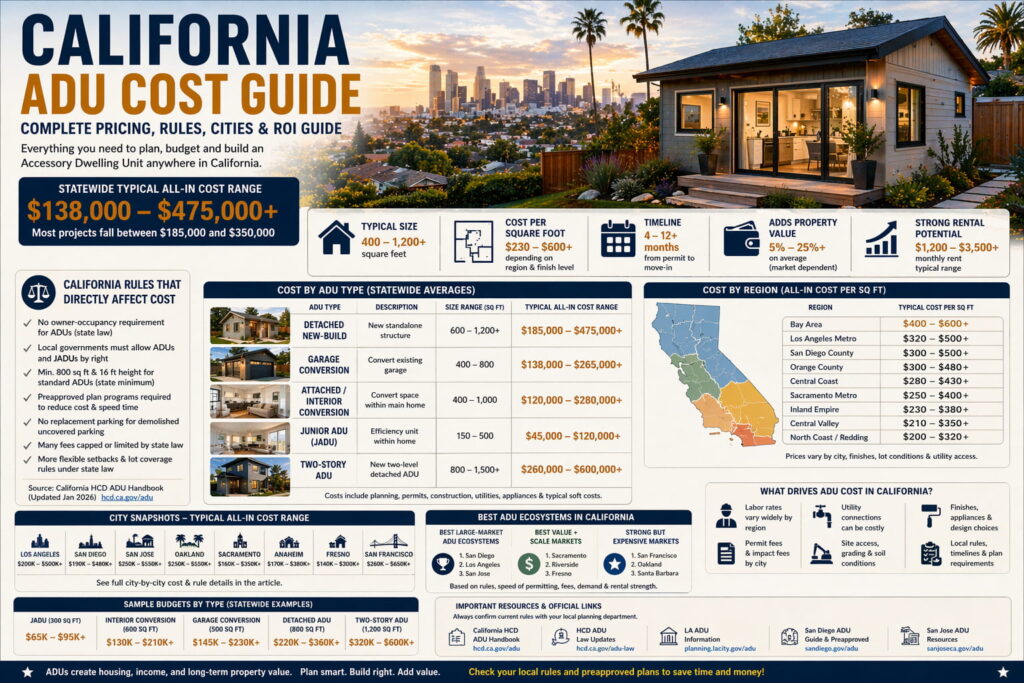
Important disclaimer: This is a planning guide, not a quote and not legal advice. Actual bids vary by city, zoning overlays, lot shape, slope, utility routes, tree constraints, wildfire rules, coastal requirements, historic review, finish package, and contractor availability. Use these ranges to budget and to compare bids apples-to-apples.
California ADU cost in 2026 (quick answer)
For most California homeowners, a realistic all-in ADU budget usually lands in the mid-six figures to mid/high $400Ks, depending on region and type.
Typical all-in California ADU cost ranges (2026)
| Project scenario | Typical size | Typical California all-in cost |
|---|---|---|
| Garage conversion ADU | 400–700 sf | $120k–$260k |
| Basement / interior conversion | 450–800 sf | $110k–$240k |
| Attached ADU / addition | 500–800 sf | $180k–$360k |
| Detached new-build ADU | 500–800 sf | $240k–$520k |
| Above-garage ADU | 500–800 sf | $230k–$500k |
| Prefab / modular installed | 400–800 sf | $190k–$420k |
| JADU | 150–500 sf | $60k–$180k |
What “all-in” means in this guide
When I say all-in, I mean a planning budget that usually includes:
- design and drafting
- structural engineering and common consultants
- permits and typical local fees
- construction labor and materials
- contractor overhead and profit
- a reasonable contingency
What it may not fully include:
- major retaining walls or slope stabilization
- unusual sewer or water upgrades
- difficult access or crane logistics
- premium architecture or custom finishes
- exceptional coastal, wildfire, or historic-review costs
1) California ADU rules that directly affect cost
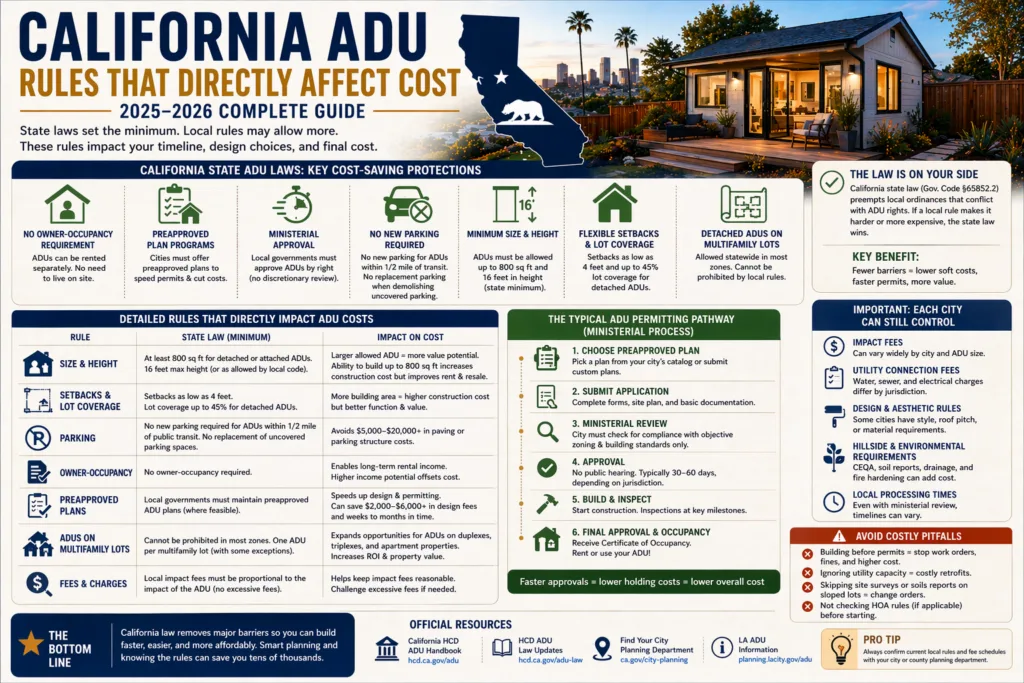
California’s state ADU framework is one of the biggest reasons the market is so active. The legal baseline matters because uncertainty is expensive.
If you want the official statewide source, the California Department of Housing and Community Development’s ADU page and current ADU Handbook are the first places I would send any homeowner.
A) California still has one of the strongest statewide ADU baselines in the U.S.
California law heavily limits how much local agencies can block standard ADU projects. That matters because when a state narrows local discretion, homeowners spend less time and money fighting basic entitlement issues.
B) The 800 sf / 16 foot rule is still one of the most important cost anchors
Under state law, local agencies must generally allow an ADU of at least:
- 800 square feet
- 16 feet in height
- with 4-foot side and rear setbacks
Why this matters: this is the size sweet spot for a huge percentage of California ADU projects. It gives homeowners a realistic path to a true 1-bedroom or compact 2-bedroom unit without having to negotiate a special design exception.
It is also the size where the impact fee exemption stops, which is a separate question from whether you are allowed to build it. We price both sides of that line on the 600 sq ft and 800 sq ft cost pages, and the full cost by size index covers 1,000 and 1,200 sq ft along with the 1 and 2 bedroom versions of the same question.
C) Owner occupancy is no longer a standard ADU blocker
California removed ADU owner-occupancy requirements for ADUs. That matters for:
- financing flexibility
- long-term rental strategy
- family-use scenarios where the owner is not living in the main house full-time
There is still nuance for JADUs, especially where shared sanitation is involved, so that is one place to verify carefully.
D) Impact fee rules directly affect budget
California’s fee rules matter a lot.
In general:
- ADUs 750 sf and smaller are exempt from impact fees
- larger ADUs can only be charged impact fees in proportion to the size of the ADU relative to the primary home
Why this matters: this is one of the biggest reasons smaller ADUs can pencil better than people expect in California.
E) Local agencies must have preapproved plan pathways
State law now requires jurisdictions to create a process for preapproved ADU plans. This does not mean every city’s program is equally strong, but it does matter because preapproved plans can reduce:
- design time
- soft costs
- permit review friction
F) California keeps making it easier to legalize some unpermitted ADUs
This is a major but under-discussed cost category.
California law has expanded protections for some unpermitted ADUs and JADUs that were built before January 1, 2020. That matters because legalization projects can be much cheaper than ground-up new construction if the unit is structurally sound and the corrections are manageable.
G) Multifamily lots are much more powerful than many owners realize
California law now allows significant ADU potential on multifamily properties, including detached ADUs on qualifying lots. This is a huge deal for duplex, triplex, and apartment property owners.
H) Local review still matters, especially in hillside, coastal, historic, and wildfire contexts
California is not one uniform market. Even with strong state law, costs can still jump because of:
- coastal zone review
- hillside grading and retaining
- historic district or design overlay expectations
- wildfire hardening in certain areas
- utility and sewer realities
2) The California ADU cost formula (the practical way to budget)
Use this formula:
Total California ADU budget
= base all-in cost by type and size
- regional labor and fee factor
- site and utility risk
- coastal / wildfire / hillside / historic factors where relevant
- finish package upgrades
- contingency
Step 1: Pick your region
California is not one labor market.
Step 2: Pick your ADU type
Detached is usually the most expensive common path. Conversions are often the cheapest.
Step 3: Pick your realistic size
For California, the most useful planning buckets are:
- 150–500 sf JADU or compact studio
- 350–500 sf studio or compact 1-bed
- 500–650 sf 1-bed sweet spot
- 650–800 sf larger 1-bed or compact 2-bed
- 800–1,200 sf where local standards, budget, and site support it
Step 4: Stress-test the lot
Ask early:
- flat or sloped?
- sewer or septic?
- easy access or tight lot?
- coastal, wildfire, or hillside rules?
- historic review or tree constraints?
Step 5: Hold a real contingency
My California rule of thumb:
- straightforward conversion: 8%–10%
- standard attached or detached ADU: 10%–15%
- hillside, coastal, septic, utility-heavy, or complex review project: 15%–20%
3) California ADU cost by type
A) Detached new-build ADU
This is the dream ADU for many homeowners. It is also usually the most expensive common path because you are building a complete second home from scratch.
| Detached ADU size | Typical California all-in range | Planning $/sf (all-in) |
|---|---|---|
| 500 sf | $220k–$340k | $440–$680 |
| 650 sf | $260k–$430k | $400–$662 |
| 800 sf | $300k–$520k | $375–$650 |
| 1,000 sf | $370k–$650k+ | $370–$650+ |
Why detached ADUs cost more in California
- full foundation and structure
- utility trenching and tie-ins
- higher labor rates in coastal and major metro markets
- more likely sitework, drainage, or tree coordination
- more exposure to overlay and design review issues
B) Garage conversion ADU
Garage conversions can be the best value when the structure is sound and the utility route is short.
| Garage conversion size | Typical California all-in range | Planning $/sf (all-in) |
|---|---|---|
| 400 sf | $100k–$160k | $250–$400 |
| 500 sf | $125k–$200k | $250–$400 |
| 650 sf | $160k–$260k | $246–$400 |
What typically drives garage conversion cost
- slab/foundation issues
- full insulation and weatherization upgrades
- new kitchen and bath plumbing
- windows, doors, and egress changes
- roof/framing corrections on older garages
C) Basement / interior conversion ADU
This is often the cheapest path where the shell already exists and headroom, moisture, and egress cooperate.
| Basement / interior size | Typical California all-in range | Planning $/sf (all-in) |
|---|---|---|
| 450 sf | $95k–$155k | $211–$344 |
| 650 sf | $130k–$195k | $200–$300 |
| 800 sf | $160k–$240k | $200–$300 |
Why interior conversions can pencil well
- the shell already exists
- no detached foundation in the same way
- utility routes may be shorter
Why they still go sideways
- low ceiling height
- water intrusion or drainage issues
- expensive egress fixes
- reworking plumbing slope
D) Attached ADU / addition
Attached ADUs sit in the middle. They can save on utility runs, but tie-ins to the main house can become more complex than homeowners expect.
| Attached ADU size | Typical California all-in range | Planning $/sf (all-in) |
|---|---|---|
| 500 sf | $170k–$260k | $340–$520 |
| 650 sf | $210k–$320k | $323–$492 |
| 800 sf | $250k–$360k | $313–$450 |
E) Above-garage ADU
Above-garage ADUs are usually engineering-heavy, which is why they often cost more than people expect.
| Above-garage size | Typical California all-in range | Planning $/sf (all-in) |
|---|---|---|
| 500 sf | $190k–$290k | $380–$580 |
| 650 sf | $235k–$375k | $362–$577 |
| 800 sf | $280k–$500k | $350–$625 |
F) Prefab / modular installed
Prefab can improve predictability and sometimes schedule, but the full installed number still includes foundation, transport, utilities, and site prep.
| Prefab / modular size | Typical California all-in range | Planning $/sf (all-in) |
|---|---|---|
| 400 sf | $145k–$230k | $363–$575 |
| 650 sf | $200k–$320k | $308–$492 |
| 800 sf | $250k–$420k | $313–$525 |
G) JADU (Junior ADU)
JADUs are one of the most underrated California pathways because they can solve a family-use or rental-flex problem without forcing a full detached build.
| JADU size | Typical California all-in range | Planning $/sf (all-in) |
|---|---|---|
| 150 sf | $35k–$70k | $233–$467 |
| 300 sf | $50k–$110k | $167–$367 |
| 500 sf | $80k–$180k | $160–$360 |
Where JADUs shine
- family member housing
- office-to-future-housing flexibility
- homeowners who want a lower-cost second unit path
- lots where a full detached ADU is overkill
4) California ADU cost per square foot
If you want a shorthand, use this table and then adjust for site conditions.
| ADU type | Typical California all-in $/sf |
|---|---|
| Garage conversion | $250–$400 |
| Basement / interior conversion | $200–$345 |
| Attached ADU / addition | $320–$520 |
| Detached new-build ADU | $375–$680+ |
| Above-garage ADU | $350–$625 |
| Prefab / modular installed | $300–$550 |
| JADU | $160–$467 |
Why small California ADUs cost more per square foot
A 400 sf ADU still needs:
- a kitchen or efficiency kitchen
- a bathroom
- HVAC
- electrical and plumbing work
- permits and inspections
- utility routing
That is why a very small ADU does not cost half as much as a larger one.
5) California ADU cost by region
A) Los Angeles and core coastal Southern California
This is one of the deepest ADU markets in the U.S., but it is also one of the most expensive and most consultant-heavy.
| Project type | Typical all-in range in Los Angeles / coastal SoCal core |
|---|---|
| Conversion ADU | $130k–$250k |
| Attached ADU | $200k–$380k |
| Detached ADU | $280k–$560k |
What drives cost here
- older urban lots
- design/consultant costs
- utility complexity
- hillside and access constraints in many neighborhoods
- labor pricing in major coastal markets
B) Orange County
Orange County is not cheap, but it is one of the most practical major ADU markets because many lots are suburban enough to physically support ADUs while still carrying very strong housing demand.
| Project type | Typical all-in range in Orange County |
|---|---|
| Conversion ADU | $125k–$240k |
| Attached ADU | $195k–$360k |
| Detached ADU | $270k–$520k |
C) San Diego County
San Diego is one of the most important California ADU markets because the city has gone further than most places on financing, guidance, and unit production.
| Project type | Typical all-in range in San Diego County |
|---|---|
| Conversion ADU | $125k–$235k |
| Attached ADU | $190k–$350k |
| Detached ADU | $260k–$500k |
D) Inner Bay Area (San Francisco, San Jose, Peninsula)
This is usually the most expensive California ADU region.
| Project type | Typical all-in range in inner Bay Area |
|---|---|
| Conversion ADU | $150k–$280k |
| Attached ADU | $230k–$420k |
| Detached ADU | $320k–$650k+ |
What drives cost here
- premium labor and subcontractors
- more design expectations
- tighter lots and access limits
- older homes, utility complexity, and hillside sites
E) East Bay and North Bay
This region is broad. Oakland is not Walnut Creek, and Santa Rosa is not Berkeley, but the general cost band is still below the inner Bay core in many submarkets.
| Project type | Typical all-in range in East Bay / North Bay |
|---|---|
| Conversion ADU | $130k–$245k |
| Attached ADU | $200k–$370k |
| Detached ADU | $280k–$560k |
F) Sacramento and the Capital Region
This is one of the strongest value-and-volume ADU markets in California.
| Project type | Typical all-in range in Sacramento region |
|---|---|
| Conversion ADU | $110k–$210k |
| Attached ADU | $170k–$320k |
| Detached ADU | $230k–$430k |
G) Inland Empire
The Inland Empire is one of the most practical California ADU markets for homeowners who want California ADU demand without Los Angeles or Bay Area pricing.
| Project type | Typical all-in range in Inland Empire |
|---|---|
| Conversion ADU | $110k–$220k |
| Attached ADU | $175k–$330k |
| Detached ADU | $240k–$450k |
H) Central Valley
This is often where California ADUs still pencil best on a pure construction-cost basis.
| Project type | Typical all-in range in Central Valley |
|---|---|
| Conversion ADU | $100k–$200k |
| Attached ADU | $160k–$300k |
| Detached ADU | $220k–$400k |
I) Central Coast
The Central Coast is not as expensive as the inner Bay core in every market, but it can be surprisingly costly because of labor pool limits, coastal conditions, and permitting friction.
| Project type | Typical all-in range in Central Coast |
|---|---|
| Conversion ADU | $130k–$245k |
| Attached ADU | $200k–$370k |
| Detached ADU | $280k–$550k |
J) Northern and smaller California markets
Many smaller markets can be more affordable, but utility realities, septic, wildfire zones, and contractor availability can erase the headline savings fast.
| Project type | Typical all-in range in northern/smaller CA markets |
|---|---|
| Conversion ADU | $100k–$210k |
| Attached ADU | $165k–$310k |
| Detached ADU | $220k–$430k |
6) California city-by-city ADU cost snapshots
These are planning-level numbers for the California cities readers ask about most often.
| City / market | Detached ADU (typical all-in) | Conversion ADU (typical all-in) | What usually drives cost |
|---|---|---|---|
| Los Angeles | $280k–$560k | $130k–$250k | urban lots, consultants, utilities, hillside access |
| Long Beach | $260k–$500k | $125k–$235k | coastal labor pricing, older lots, utility routing |
| San Diego | $260k–$500k | $125k–$235k | high demand, coastal pricing, strong ADU pipeline |
| Anaheim | $250k–$460k | $120k–$220k | large suburban stock, utility and sewer checks |
| Santa Ana | $250k–$470k | $120k–$225k | dense lots, strong demand, urban utility realities |
| Riverside | $235k–$430k | $110k–$215k | good value relative to coastal counties |
| San Bernardino | $225k–$410k | $105k–$205k | more value-oriented build environment |
| San Jose | $320k–$650k+ | $150k–$280k | inner Bay labor, design expectations, premium sites |
| Oakland | $290k–$560k | $135k–$245k | older stock, lot access, hillside in some neighborhoods |
| San Francisco | $340k–$700k+ | $160k–$300k | tight lots, premium labor, complex review conditions |
| Sacramento | $230k–$420k | $110k–$205k | strong value market, good lot practicality |
| Fresno | $220k–$390k | $100k–$195k | one of the best value city markets in the state |
| Bakersfield | $215k–$380k | $100k–$190k | lower labor pricing, suburban lot practicality |
| Modesto | $220k–$395k | $105k–$195k | Central Valley economics, family-use demand |
| Stockton | $225k–$405k | $105k–$200k | value relative to Bay spillover markets |
| Santa Rosa | $270k–$520k | $130k–$235k | North Bay labor and wildfire-aware design |
| Santa Barbara | $300k–$620k | $145k–$270k | coastal review, design expectations, labor costs |
| Ventura | $270k–$520k | $130k–$240k | coastal labor, demand, utility conditions |
7) California’s strongest ADU cities and markets right now
This is where I want to add genuinely useful, net-new context.
Not every “good” ADU market is the cheapest market. Some cities are strong because they combine:
- real housing demand
- practical lot patterns
- strong state-law alignment
- city-level programs that reduce friction
- homeowner economics that still make the project worth doing
Tier 1: Best large-market ADU ecosystems
These are the California markets where ADUs are not just legal, but structurally active.
1) Los Angeles
Los Angeles remains one of the biggest ADU ecosystems in the country. The city’s rules are mature, the market is deep, and a huge share of parcels can support some kind of ADU or JADU pathway. If readers want the local rule summary, Los Angeles City Planning’s ADU regulations page and the city’s current ZA Memo 143 are worth linking naturally inside the article.
2) San Diego
San Diego stands out because it is not just permissive. It has also built public-facing tools and financing support. The city’s official ADU page and permit bulletin make it one of the more visible ADU ecosystems for homeowners.
3) San Jose
San Jose is one of the strongest “process” cities because it leans hard into state law, checklists, and homeowner-facing ADU guidance. The city’s official ADU page is a good model of how a city can make the rules feel less mysterious.
Tier 2: Best value-plus-scale markets
These are cities where the economics can be much better than LA or the inner Bay Area, while demand is still strong.
4) Sacramento
Sacramento is one of the most balanced ADU markets in California. Costs are meaningfully lower than the Bay Area and coastal SoCal, while the city still offers real ADU infrastructure. Sacramento’s ADU page and preapproved plan program make it especially interesting.
5) Anaheim and broader Orange County suburbs
Anaheim is notable because it has a clear ADU Anaheim portal plus an ADU Express pathway and preapproved plan catalog. That is a real example of a city reducing friction, not just claiming to support ADUs.
6) Fresno
Fresno is one of the most important “cost-efficiency” ADU cities in California because it pairs a lower cost base with public-facing preapproved plans. The city’s ADU Program is worth mentioning because it shows how Valley cities can make ADUs more practical.
Tier 3: Strong but expensive markets
These markets can be excellent for ADUs, but they punish design mistakes and site complexity.
7) Oakland
Oakland stands out because it offers pre-approved ADU plans and a clearer homeowner pathway than many cities with older housing stock.
8) San Francisco
San Francisco is still one of the hardest and most expensive ADU markets, but it remains important because of demand and the strength of the underlying real estate. The city’s official ADU topic page is worth linking for readers who want the local process.
The net-new insight I want this article to give readers
The “best” California ADU city is not automatically the biggest city or the cheapest city.
The best city is often the one where these three things align:
- state law is fully reflected in local process
- the lot types are physically workable
- the city offers some real soft-cost relief, like preapproved plans, faster review, or clearer checklists
That is why Sacramento, Anaheim, Fresno, and some Inland Empire markets can be more practical for many homeowners than famous but punishingly expensive markets like San Francisco or Santa Barbara.
8) California hidden costs that blow up ADU budgets
These are the line items that most often turn a “reasonable” ADU into a surprise project.
| Hidden cost item | When it appears | Typical planning impact |
|---|---|---|
| Utility service upgrade | existing electrical or water service is undersized | $3k–$15k+ |
| Sewer connection or line changes | existing line inadequate or route is difficult | $5k–$25k+ |
| Long trenching to detached ADU | backyard siting far from utilities | $5k–$20k+ |
| Slope / retaining walls | hillside or grade problems | $15k–$100k+ |
| Coastal review and related design work | coastal-zone projects | time + redesign + fees |
| Historic or landmark review complications | older neighborhoods and districts | time + redesign + fees |
| Tree protection / removal | lots with significant trees or overlays | $2k–$25k+ |
| Wildfire hardening | certain inland or foothill communities | $5k–$30k+ |
| Septic upgrade | rural or fringe properties | $10k–$40k+ |
| Difficult site access / crane logistics | tight urban or steep lots | $5k–$30k+ |
The California-specific budget truth
In California, homeowners most often underestimate:
- utility routing for detached ADUs
- slope and retaining costs
- how much city-specific process changes soft costs
- the real premium in coastal and Bay Area labor markets
- how much money preapproved plans can save when they actually fit the lot
9) California ADU cost by lot profile
A) Simple lot
Flat, normal access, short utility runs, no big tree, septic, or hillside complications.
| Project type | Typical all-in on a simple lot |
|---|---|
| Conversion ADU | $110k–$200k |
| Attached ADU | $175k–$310k |
| Detached ADU | $240k–$380k |
B) Moderate lot
Longer trenching, limited access, some drainage, maybe tighter setbacks or more design coordination.
| Project type | Typical all-in on a moderate lot |
|---|---|
| Conversion ADU | $125k–$225k |
| Attached ADU | $200k–$345k |
| Detached ADU | $280k–$460k |
C) Difficult lot
Slope, retaining walls, major utility work, coastal or hillside issues, septic uncertainty, or meaningful review complications.
| Project type | Typical all-in on a difficult lot |
|---|---|
| Conversion ADU | $145k–$260k+ |
| Attached ADU | $230k–$390k+ |
| Detached ADU | $340k–$650k+ |
10) California fee strategy and soft-cost accelerators
This is a section most generic articles miss.
A) Why 750 sf is such an important California threshold
In many markets, 750 sf and under is not just easier physically. It is a major fee strategy because of impact-fee exemptions.
B) Why preapproved plans matter more in California than in many states
California’s size, labor pricing, and soft-cost burden make preapproved plans especially powerful when they actually fit the site.
These cities are worth watching because they offer visible preapproved or expedited ADU pathways:
- San Jose
- Sacramento
- Oakland
- Anaheim
- Fresno
C) The real soft-cost hierarchy in California
If your goal is to reduce total project cost, the best sequence is often:
- choose the right type for the lot
- stay at or under the size threshold that keeps fees lighter
- use a preapproved or near-standardized plan if possible
- keep the footprint simple
- place the unit near existing utilities
That matters more than obsessing over countertops.
11) Finish level: what design choices do to the California budget
| Finish level | Typical impact | Example on a $320k detached ADU |
|---|---|---|
| Value / builder-grade | baseline | $320k |
| Mid-range | +5% to +15% | $336k–$368k |
| High-end / custom | +15% to +35%+ | $368k–$432k+ |
The upgrades that move the budget fastest
| Upgrade | Typical adder | Why it matters |
|---|---|---|
| Premium kitchen package | +$8k–$40k+ | Cabinetry and appliances scale quickly |
| Second bathroom | +$12k–$30k | More MEP and finish work |
| Large custom windows/doors | +$5k–$25k+ | Product + structure + labor |
| High-end exterior cladding | +$5k–$20k+ | Material and detailing cost |
| Deck / stairs / covered patio | +$5k–$30k+ | Structure, rails, weather detailing |
| Higher-performance mechanical package | +$5k–$20k | Comfort, efficiency, controls |
12) Three California sample budgets that feel real
Example A: 500 sf garage conversion in Sacramento
| Budget category | Planning range |
|---|---|
| Design + engineering | $8,000–$16,000 |
| Permits + fees | $4,000–$12,000 |
| Structure/slab/framing fixes | $12,000–$28,000 |
| Plumbing + electrical + HVAC | $28,000–$55,000 |
| Insulation, drywall, finishes | $35,000–$60,000 |
| Utility/sitework | $5,000–$12,000 |
| Contingency | $10,000–$18,000 |
| Total | $102,000–$201,000 |
Example B: 650 sf detached ADU in Los Angeles on a typical lot
| Budget category | Planning range |
|---|---|
| Design + engineering | $14,000–$28,000 |
| Permits + fees | $8,000–$24,000 |
| Foundation + sitework | $24,000–$55,000 |
| Framing + shell + windows/doors | $75,000–$140,000 |
| MEP | $38,000–$72,000 |
| Interior finishes | $38,000–$72,000 |
| Contingency | $20,000–$35,000 |
| Total | $217,000–$426,000 |
Example C: 800 sf detached ADU in the Bay Area on a tough lot
| Budget category | Planning range |
|---|---|
| Design + engineering | $18,000–$40,000 |
| Permits + fees | $10,000–$30,000 |
| Sitework, utilities, drainage, retaining | $40,000–$130,000 |
| Foundation + envelope | $95,000–$180,000 |
| MEP | $45,000–$85,000 |
| Interior finishes | $40,000–$85,000 |
| Contingency | $25,000–$45,000 |
| Total | $273,000–$595,000+ |
13) Natural government resource links readers will actually use
When readers want to verify a California ADU rule themselves, these are the resources worth linking naturally inside the article:
- California HCD’s ADU page
- California HCD’s current ADU Handbook
- Los Angeles City Planning’s ADU regulations page
- Los Angeles City Planning’s ZA Memo 143
- San Diego’s official ADU page
- San Diego’s ADU/JADU permit bulletin
- San Jose’s official ADU page
- Sacramento’s official ADU page
- Sacramento’s preapproved ADU plan program
- Oakland’s official ADU page and pre-approved plans
- Anaheim’s ADU Anaheim page and ADU Express
- Fresno’s ADU Program
- San Francisco’s ADU topic page
14) How to lower your California ADU cost without regretting it
| Cost lever | What to do | Why it saves money |
|---|---|---|
| Place the ADU near utilities | Shorter trenching and easier tie-ins | Utilities are one of the biggest statewide wildcards |
| Keep the footprint simple | Rectangle or simple form | Less foundation and framing complexity |
| Choose the right type for the lot | Sometimes conversion beats detached by a lot | Existing shell can save tens of thousands |
| Stay at or under strategic size thresholds | Especially 750 sf for fee reasons | Can materially improve project economics |
| Use preapproved plans when the lot fits | Reduce soft costs and review friction | Best where the city process is actually mature |
| Lock finish allowances early | Make bids comparable | Reduces change orders and scope drift |
My biggest statewide California advice
Do not ask only, “What does an ADU cost in California?”
Ask instead:
- What does this type cost in this city on this lot under this fee and review structure?
That is where the real number lives.
15) FAQs about California ADU costs
Are ADUs legal in California?
Yes. California has one of the strongest statewide ADU frameworks in the country.
What is the cheapest type of ADU in California?
Usually a JADU, basement/interior conversion, or garage conversion, if the existing space and utility routes cooperate.
What is the most expensive common type?
Usually a detached new-build ADU or above-garage ADU, especially in Bay Area or coastal markets.
What is the most important fee threshold to know?
750 square feet, because ADUs at or under that size are generally exempt from impact fees.
Which California cities are strongest for ADU demand right now?
Los Angeles, San Diego, San Jose, Sacramento, Anaheim, Oakland, Fresno, and several Inland Empire and Orange County suburban markets.
Can prefab be a good option in California?
Yes, especially where schedule and predictability matter, but the full cost still includes foundations, delivery, utility hookups, and site prep.
Can California cities still make ADUs expensive even with strong state law?
Yes. Hillside sites, coastal review, utility upgrades, historic overlays, and labor-market differences can still move costs dramatically.
Final takeaway
California is still the national leader in ADU activity, but it is not a one-number market.
The budget still lives or dies on the same five things:
- region
- ADU type
- size
- lot difficulty
- utility and review reality
That is especially true in California because the difference between a flat suburban lot in Fresno and a constrained hillside parcel in the Bay Area can be enormous.
If you want a California ADU number you can actually trust, do not stop at the statewide average.
Get specific about the city, type, size, and lot.
ADU cost by size
Same cost engine, priced by size rather than by place. Each page carries a per-city table, so you can read the California numbers at the size you are actually planning.
Cities in California
City-level ADU cost and permit-timeline breakdowns within California.
Anaheim
$120,000–$460,000
Campbell
$155,000–$600,000
Cupertino
$160,000–$700,000
Fresno
$100,000–$390,000
Long Beach
$120,000–$500,000
Los Altos
$180,000–$750,000
Los Angeles
$140,000–$400,000
Los Gatos
$190,000–$750,000
Oakland
$135,000–$560,000
Riverside
$110,000–$430,000
Sacramento
$110,000–$420,000
San Diego
$125,000–$500,000
San Francisco
$160,000–$700,000
San Jose
$150,000–$650,000
Santa Clara
$160,000–$680,000
Saratoga
$190,000–$750,000
Sunnyvale
$160,000–$675,000