
Colorado is quickly becoming one of the most important ADU states in the country. But statewide momentum does not mean every Colorado ADU is simple, cheap, or approved the same way.
Colorado is a state of sharp contrasts:
- Denver lots with high permit and design expectations
- Front Range suburbs with larger yards but rising labor costs
- Boulder-area projects with stricter site and design realities
- mountain and wildfire-prone communities, where slope, snow load, access, and utility constraints can move the budget fast
That is why a serious Colorado ADU article cannot stop at one “average number.”
This guide follows the same structure as our other master ADU cost guides and answers the real homeowner question:
How much does an ADU cost in Colorado, and how do costs change by city, region, lot type, and ADU type?
We will cover the real numbers by type, size, region, and city, then show which Colorado markets are the most practical and which ones carry the biggest cost risk.
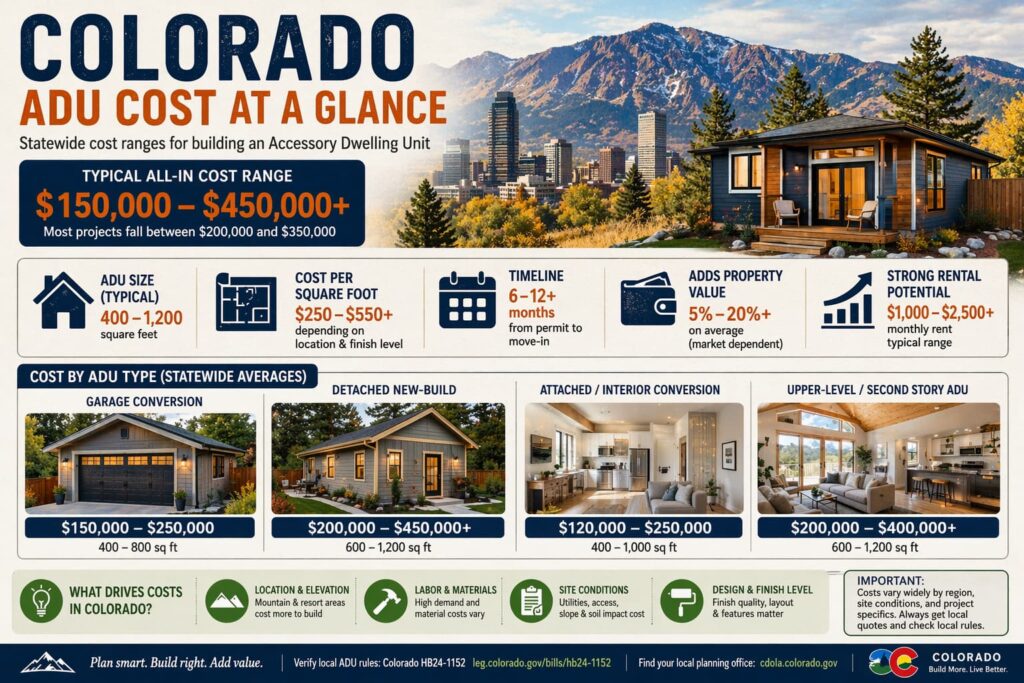
Important disclaimer: This is a planning guide, not a quote and not legal advice. Actual bids vary by city, zoning, site slope, wildfire requirements, utility routes, HOA constraints, historic review, finish level, and contractor availability. Use these ranges to budget and to compare bids apples-to-apples.
Colorado ADU cost in 2026 (quick answer)
For most Colorado homeowners, a realistic all-in ADU budget usually lands in the mid-six figures to mid/high $400Ks, depending on region and type.
Typical all-in Colorado ADU cost ranges (2026)
| Project scenario | Typical size | Typical Colorado all-in cost |
|---|---|---|
| Garage conversion ADU | 400–700 sf | $120k–$240k |
| Basement / interior conversion | 450–800 sf | $110k–$235k |
| Attached ADU / addition | 500–800 sf | $180k–$350k |
| Detached new-build ADU | 500–800 sf | $240k–$500k |
| Above-garage ADU | 500–800 sf | $230k–$480k |
| Prefab / modular installed | 400–800 sf | $180k–$380k |
What “all-in” means in this guide
When I say all-in, I mean a planning budget that usually includes:
- design and drafting
- structural engineering and common consultants
- permits and typical local fees
- construction labor and materials
- contractor overhead and profit
- a reasonable contingency
What it may not fully include:
- major retaining walls or slope stabilization
- unusual sewer or water upgrades
- difficult site access or crane logistics
- premium architecture or custom finishes
- exceptional wildfire-hardening or snow-load-driven structural costs
1) Colorado ADU rules that directly affect cost
Colorado’s statewide ADU rules matter because they change not only legality, but also friction. In ADU projects, friction costs money.
A) Colorado’s 2024 ADU law created a stronger statewide baseline in subject jurisdictions
Colorado’s ADU law, HB24-1152, requires certain subject jurisdictions to allow one ADU as an accessory use to a single-unit detached dwelling wherever single-unit detached homes are allowed, using an administrative approval process.
In practice, the law applies to:
- municipalities with a population of 1,000 or more that are inside a metropolitan planning organization, and
- certain county areas inside MPOs that meet the state’s population thresholds
Why this matters: in many of Colorado’s biggest ADU markets, the legal baseline is now much better than it was a few years ago.
B) The law limits some of the local rules that usually make ADUs more expensive
On or after June 30, 2025, subject jurisdictions generally cannot:
- require construction of a new off-street parking space for an ADU, except in limited cases
- require the ADU or another home on the lot to be owner-occupied, with only limited application-time exceptions
- apply restrictive design or dimension standards to ADUs
- require a statement from a water or wastewater provider as a permitting condition
Colorado’s ADU law itself is the best source if you want to verify the exact language. I’d point readers to the bill text directly when questions come up.
C) Administrative approval matters more than people think
Colorado defines administrative approval as a process based on objective standards, without a public hearing or elected-board decision in the normal case.
Why it matters for budget: the more discretionary a housing approval process becomes, the more you pay in design revisions, consultant time, delay, and financing risk.
D) Not every Colorado community is the same
This is important.
Colorado’s new law improves the baseline in subject jurisdictions, but Colorado is not one uniform ADU market. Mountain towns, non-subject jurisdictions, wildfire-heavy areas, and older HOA-controlled neighborhoods can still be very different from Denver, Boulder, or Colorado Springs.
E) HOAs are also more limited than they used to be
Colorado now limits the ability of HOAs in certain jurisdictions to block ADUs outright in ways the statute prohibits. The legislature’s own HOA law summary explains this clearly in plain English, and it is worth checking if your lot is inside a common-interest community.
F) Local governments can go beyond the minimum and become “ADU supportive jurisdictions”
Colorado’s law also created a pathway for local governments to become certified accessory dwelling unit supportive jurisdictions, which can help them qualify for grant support and other incentives if they do more than the minimum.
That matters because it encourages:
- fee reduction
- better permitting pathways
- affordability incentives
- clearer local code updates
Colorado DOLA’s housing pages and compliance announcements are good places to track how aggressively local governments are moving.
2) The Colorado ADU cost formula (the practical way to budget)
Use this formula:
Total Colorado ADU budget
= base all-in cost by type and size
- regional labor and fee factor
- site and utility risk
- mountain / climate / wildfire factors where relevant
- finish package upgrades
- contingency
Step 1: Pick your region
Colorado is not one labor market.
Step 2: Pick your ADU type
Detached is usually the most expensive common path. Conversions are often the cheapest.
Step 3: Pick your realistic size
For Colorado, the most useful planning buckets are:
- 350–500 sf studio or compact 1-bed
- 500–650 sf 1-bed sweet spot
- 650–800 sf larger 1-bed or compact 2-bed
- 800–1,000 sf where local rules, lot conditions, and budget support it
Step 4: Stress-test the lot
Ask early:
- flat or sloped?
- sewer or septic?
- easy access or tight lot?
- wildfire zone or high snow load?
- historic review or HOA exposure?
Step 5: Hold a real contingency
My Colorado rule of thumb:
- straightforward conversion: 8%–10%
- standard attached or detached ADU: 10%–15%
- mountain, slope, septic, or wildfire-heavy project: 15%–20%
3) Colorado ADU cost by type
A) Detached new-build ADU
This is the dream scenario for many homeowners. It is also usually the most expensive common path because you are building a complete second home from scratch.
| Detached ADU size | Typical Colorado all-in range | Planning $/sf (all-in) |
|---|---|---|
| 500 sf | $210k–$320k | $420–$640 |
| 650 sf | $250k–$400k | $385–$615 |
| 800 sf | $290k–$500k | $363–$625 |
Why detached ADUs cost more in Colorado
- full foundation and structure
- utility trenching and tie-ins
- higher labor rates in many Front Range markets
- snow load, wind, and wildfire-driven detailing in some regions
- more likely sitework and access costs
B) Garage conversion ADU
Garage conversions can be the best value when the structure is sound and the utility route is short.
| Garage conversion size | Typical Colorado all-in range | Planning $/sf (all-in) |
|---|---|---|
| 400 sf | $95k–$145k | $238–$363 |
| 500 sf | $120k–$175k | $240–$350 |
| 650 sf | $150k–$240k | $231–$369 |
What typically drives garage conversion cost
- slab/foundation issues
- full insulation and weatherization upgrades
- new kitchen and bath plumbing
- windows, doors, and egress changes
- roof/framing corrections on older garages
C) Basement / interior conversion ADU
This is often the cheapest path where the shell already exists and headroom, moisture, and egress cooperate.
| Basement / interior size | Typical Colorado all-in range | Planning $/sf (all-in) |
|---|---|---|
| 450 sf | $90k–$150k | $200–$333 |
| 650 sf | $125k–$190k | $192–$292 |
| 800 sf | $155k–$235k | $194–$294 |
Why basement ADUs can pencil well
- the shell already exists
- no detached foundation in the same way
- utility routes may be shorter
Why they still go sideways
- low ceiling height
- water intrusion or drainage issues
- expensive egress fixes
- reworking plumbing slope
D) Attached ADU / addition
Attached ADUs often sit in the middle. They can save on utility runs, but tie-ins to the main house can become more complex than homeowners expect.
| Attached ADU size | Typical Colorado all-in range | Planning $/sf (all-in) |
|---|---|---|
| 500 sf | $165k–$245k | $330–$490 |
| 650 sf | $200k–$300k | $308–$462 |
| 800 sf | $235k–$350k | $294–$438 |
E) Above-garage ADU
Above-garage ADUs are usually engineering-heavy, which is why they often cost more than people expect.
| Above-garage size | Typical Colorado all-in range | Planning $/sf (all-in) |
|---|---|---|
| 500 sf | $190k–$285k | $380–$570 |
| 650 sf | $230k–$365k | $354–$562 |
| 800 sf | $270k–$480k | $338–$600 |
F) Prefab / modular installed
Prefab can improve predictability and sometimes schedule, but the full installed number still includes foundation, transport, utilities, and site prep.
| Prefab / modular size | Typical Colorado all-in range | Planning $/sf (all-in) |
|---|---|---|
| 400 sf | $140k–$220k | $350–$550 |
| 650 sf | $185k–$290k | $285–$446 |
| 800 sf | $220k–$380k | $275–$475 |
4) Colorado ADU cost per square foot
If you want a shorthand, use this table and then adjust for site conditions.
| ADU type | Typical Colorado all-in $/sf |
|---|---|
| Garage conversion | $230–$370 |
| Basement / interior conversion | $190–$330 |
| Attached ADU / addition | $300–$490 |
| Detached new-build ADU | $380–$625+ |
| Above-garage ADU | $340–$600 |
| Prefab / modular installed | $275–$500 |
Why small Colorado ADUs cost more per square foot
A 400 sf ADU still needs:
- a kitchen
- a bathroom
- HVAC
- electrical and plumbing work
- permits and inspections
- utility routing
That is why a very small ADU does not cost half as much as a larger one.
5) Colorado ADU cost by region
A) Denver Metro
Denver Metro is the state’s deepest ADU market, but also one of the most expensive. Land values, design expectations, and permit/consultant costs are all real.
| Project type | Typical all-in range in Denver Metro |
|---|---|
| Conversion ADU | $130k–$240k |
| Attached ADU | $190k–$350k |
| Detached ADU | $260k–$520k |
What drives cost here
- urban lot constraints
- higher consultant and labor costs
- utility and design-review complexity in older neighborhoods
- historic district exposure in some submarkets
B) Boulder / Boulder County / Broomfield corridor
This is one of the hardest Colorado ADU markets to summarize with one number because lot conditions, review context, and finish expectations vary so much.
| Project type | Typical all-in range in Boulder corridor |
|---|---|
| Conversion ADU | $140k–$260k |
| Attached ADU | $210k–$380k |
| Detached ADU | $280k–$600k |
What drives cost here
- higher design expectations
- more premium finish choices
- more site-specific review in some neighborhoods
- expensive labor and subcontractors
C) Colorado Springs / Pikes Peak region
Colorado Springs is increasingly important because it combines statewide ADU momentum with a large stock of detached homes and strong family-use demand.
| Project type | Typical all-in range in Colorado Springs |
|---|---|
| Conversion ADU | $120k–$230k |
| Attached ADU | $185k–$340k |
| Detached ADU | $240k–$450k |
What drives cost here
- slope in some neighborhoods
- suburban lot opportunities
- city code updates creating new pathways but still requiring property-by-property fit checks
D) Northern Front Range (Fort Collins, Loveland, Longmont, Greeley, Windsor)
This is one of the most interesting ADU regions in Colorado because it combines steady population growth with a broad mix of lot types and housing stock.
| Project type | Typical all-in range in Northern Front Range |
|---|---|
| Conversion ADU | $120k–$225k |
| Attached ADU | $180k–$330k |
| Detached ADU | $235k–$450k |
E) Mountain / resort / high-elevation markets
These are usually the most expensive and most volatile ADU markets in the state.
| Project type | Typical all-in range in mountain/resort markets |
|---|---|
| Conversion ADU | $150k–$280k |
| Attached ADU | $230k–$420k |
| Detached ADU | $320k–$650k+ |
What drives cost here
- slope and retaining work
- high snow loads
- wildfire mitigation requirements
- difficult logistics and contractor scarcity
- shorter building seasons in some areas
F) Western Slope / Grand Junction and beyond
Western Slope projects can pencil better than mountain resort projects, but utility and site realities still matter a lot.
| Project type | Typical all-in range in Western Slope |
|---|---|
| Conversion ADU | $110k–$215k |
| Attached ADU | $170k–$310k |
| Detached ADU | $220k–$410k |
6) Colorado city-by-city ADU cost snapshots
These are planning-level numbers for the Colorado cities readers ask about most often.
| City / market | Detached ADU (typical all-in) | Conversion ADU (typical all-in) | What usually drives cost |
|---|---|---|---|
| Denver | $260k–$520k | $130k–$240k | urban lot constraints, consultants, utilities, design review |
| Boulder | $280k–$600k | $140k–$260k | design expectations, site review, premium labor |
| Colorado Springs | $240k–$450k | $120k–$230k | suburban lot fit, slope in some areas, evolving code |
| Fort Collins | $240k–$440k | $120k–$220k | strong demand, stable permitting environment, design constraints |
| Longmont | $230k–$430k | $120k–$220k | Front Range labor costs, lot utilization |
| Aurora | $240k–$460k | $125k–$230k | large-lot suburban potential, labor costs |
| Arvada | $240k–$450k | $125k–$230k | established neighborhoods, utility/site variation |
| Lakewood | $245k–$460k | $125k–$235k | older housing stock, lot access, utility routing |
| Loveland | $225k–$420k | $115k–$215k | good value relative to Denver/Boulder |
| Greeley | $215k–$390k | $110k–$205k | more value-oriented labor market |
| Windsor | $225k–$410k | $115k–$210k | growth, suburban lots, rising demand |
| Grand Junction | $220k–$410k | $110k–$210k | Western Slope logistics, lot conditions |
| Castle Rock | $250k–$470k | $130k–$240k | higher home values, finish expectations, slope in places |
| Parker | $245k–$465k | $125k–$235k | higher suburban finish expectations |
7) Colorado’s growing and high-demand ADU markets
If I were ranking Colorado’s strongest ADU markets right now, I would focus on Front Range housing pressure + lot practicality + homeowner economics, not just one raw population metric.
1) Denver
Denver is still the center of gravity for ADU awareness and policy momentum. The city now has a stronger citywide ADU framework, and demand remains strong for both family-use units and long-term rental units.
2) Colorado Springs
Colorado Springs matters because it combines population momentum, a large stock of detached homes, and a more suburban lot pattern than Denver. That creates real ADU opportunity where lots physically support detached or garage-conversion projects.
3) Aurora
Aurora is one of the most important large-lot suburban ADU markets in Colorado. For multigenerational households, it is a very practical market to watch.
4) Fort Collins
Fort Collins is one of the best “steady demand” ADU markets in the state. It has durable housing demand, university-driven pressure, and a lot of homeowner interest in flexible family-use housing.
5) Longmont
Longmont continues to matter because it sits inside the broader Front Range growth corridor while often feeling more attainable than Boulder.
6) Castle Rock and Parker
These markets are increasingly important because they pair high-value suburban housing stock with strong family-use ADU logic. Many homeowners here are not building an ADU as a starter rental asset. They are building for aging parents, adult children, office/flex space that can later convert, or long-term family planning.
7) Greeley and Windsor
These are some of the most practical Colorado ADU markets if you want the Front Range growth story without Denver or Boulder pricing.
8) Grand Junction and Western Slope centers
These are not always the first markets people mention, but they can be excellent ADU candidates where lot size, housing pressure, and family-use demand align.
9) Mountain-resort-adjacent towns
These can be powerful ADU markets on paper, but they also carry the highest build-risk profile. In these places, a detached ADU can become a much more expensive project than homeowners expect.
8) Colorado hidden costs that blow up ADU budgets
These are the line items that most often turn a “reasonable” ADU into a surprise project.
| Hidden cost item | When it appears | Typical planning impact |
|---|---|---|
| Utility service upgrade | existing electrical or water service is undersized | $3k–$15k+ |
| Sewer connection or line changes | existing line inadequate or route is difficult | $5k–$25k+ |
| Long trenching to detached ADU | backyard siting far from utilities | $5k–$20k+ |
| Slope / retaining walls | hillside or grade problems | $15k–$80k+ |
| Snow-load or wind structural upgrades | mountain and exposed sites | $5k–$35k+ |
| Wildfire mitigation / exterior hardening | wildland-urban-interface locations | $5k–$30k+ |
| Historic or landmark review complications | older neighborhoods or local districts | time + redesign + fees |
| HOA-driven redesign or process friction | common-interest communities | time + legal/approval friction |
| Septic upgrade | rural or fringe properties | $10k–$40k+ |
| Difficult site access / crane logistics | tight urban or steep mountain lots | $5k–$30k+ |
The Colorado-specific budget truth
In Colorado, homeowners most often underestimate:
- slope and retaining costs
- utility routing for detached ADUs
- climate/wildfire construction details
- HOA and design-review friction
- how fast mountain-region logistics can explode the number
9) Colorado ADU cost by lot profile
A) Simple lot
Flat, normal access, short utility runs, no big tree, septic, or wildfire complications.
| Project type | Typical all-in on a simple lot |
|---|---|
| Conversion ADU | $110k–$200k |
| Attached ADU | $170k–$300k |
| Detached ADU | $240k–$360k |
B) Moderate lot
Longer trenching, limited access, some drainage, maybe tighter setbacks or more design coordination.
| Project type | Typical all-in on a moderate lot |
|---|---|
| Conversion ADU | $125k–$225k |
| Attached ADU | $190k–$335k |
| Detached ADU | $280k–$430k |
C) Difficult lot
Slope, retaining walls, major utility work, wildfire or snow-load issues, septic uncertainty, or meaningful review complications.
| Project type | Typical all-in on a difficult lot |
|---|---|
| Conversion ADU | $145k–$260k+ |
| Attached ADU | $220k–$390k+ |
| Detached ADU | $340k–$600k+ |
10) Finish level: what design choices do to the Colorado budget
| Finish level | Typical impact | Example on a $320k detached ADU |
|---|---|---|
| Value / builder-grade | baseline | $320k |
| Mid-range | +5% to +15% | $336k–$368k |
| High-end / custom | +15% to +35%+ | $368k–$432k+ |
The upgrades that move the budget fastest
| Upgrade | Typical adder | Why it matters |
|---|---|---|
| Premium kitchen package | +$8k–$35k+ | Cabinetry and appliances scale quickly |
| Second bathroom | +$12k–$30k | More MEP and finish work |
| Large custom windows/doors | +$5k–$25k+ | Product + structure + labor |
| High-end exterior cladding | +$5k–$20k+ | Material and detailing cost |
| Deck / stairs / covered patio | +$5k–$30k+ | Structure, rails, weather detailing |
| Higher-performance mechanical package | +$5k–$20k | Comfort, controls, efficiency |
| Wildfire-conscious exterior upgrades | +$3k–$15k+ | Material and detailing changes |
11) Three Colorado sample budgets that feel real
Example A: 500 sf garage conversion in Aurora
| Budget category | Planning range |
|---|---|
| Design + engineering | $8,000–$16,000 |
| Permits + fees | $5,000–$14,000 |
| Structure/slab/framing fixes | $12,000–$30,000 |
| Plumbing + electrical + HVAC | $28,000–$58,000 |
| Insulation, drywall, finishes | $35,000–$62,000 |
| Utility/sitework | $5,000–$12,000 |
| Contingency | $10,000–$18,000 |
| Total | $103,000–$210,000 |
Example B: 650 sf detached ADU in Fort Collins on a typical lot
| Budget category | Planning range |
|---|---|
| Design + engineering | $12,000–$24,000 |
| Permits + fees | $8,000–$22,000 |
| Foundation + sitework | $22,000–$50,000 |
| Framing + shell + windows/doors | $70,000–$130,000 |
| MEP | $36,000–$68,000 |
| Interior finishes | $36,000–$68,000 |
| Contingency | $18,000–$32,000 |
| Total | $202,000–$394,000 |
Example C: 800 sf detached ADU in a mountain-adjacent Colorado market on a tough lot
| Budget category | Planning range |
|---|---|
| Design + engineering | $18,000–$38,000 |
| Permits + fees | $10,000–$28,000 |
| Sitework, utilities, drainage, retaining | $40,000–$120,000 |
| Foundation + envelope | $90,000–$170,000 |
| MEP | $45,000–$80,000 |
| Interior finishes | $40,000–$78,000 |
| Contingency | $25,000–$45,000 |
| Total | $268,000–$559,000+ |
12) Natural government resource links you should actually use
When readers want to verify a Colorado ADU rule themselves, these are the resources worth linking naturally inside the article:
- Colorado’s official HB24-1152 bill page for the statewide ADU law
- Colorado DOLA’s compliance update on strategic growth laws for where local governments are landing in practice
- Denver’s official citywide ADUs page
- Denver’s official ADU permitting page
- Boulder’s official ADU page
- Boulder’s official ADU guide
- Colorado Springs’ official ADU page
- Fort Collins’ official ADU/development review page
13) How to lower your Colorado ADU cost without regretting it
| Cost lever | What to do | Why it saves money |
|---|---|---|
| Place the ADU near utilities | Shorter trenching and easier tie-ins | Utilities are one of the biggest wildcards statewide |
| Keep the footprint simple | Rectangle or simple form | Less foundation and framing complexity |
| Choose the right type for the site | Sometimes conversion beats detached by a lot | Existing shell can save tens of thousands |
| Lock finish allowances early | Make bids comparable | Reduces change orders and scope drift |
| Stress-test slope and climate early | Especially in foothills and mountain markets | These can be true budget killers |
| Verify HOA risk before design | Do not assume the lot is friction-free | Process delays also cost money |
My biggest statewide Colorado advice
Do not ask only, “What does an ADU cost in Colorado?”
Ask instead:
- What does this type cost in this city on this lot under this review path?
That is where the real number lives.
14) FAQs about Colorado ADU costs
Are ADUs legal in Colorado?
In many of Colorado’s largest markets, yes. Colorado’s statewide ADU law created a stronger legal baseline in subject jurisdictions beginning in 2025.
Does Colorado allow cities to require parking for ADUs?
In subject jurisdictions, new off-street parking generally cannot be required for ADUs, except in limited cases.
Can Colorado cities require owner occupancy for an ADU?
Not generally in the way many cities used to. The new law sharply limits owner-occupancy requirements, with some narrow exceptions tied to application timing and short-term rentals.
What is the cheapest type of ADU in Colorado?
Usually a basement/interior conversion or a garage conversion, if the existing structure and utility routes cooperate.
What is the most expensive common type?
Usually a detached new-build ADU or above-garage ADU, especially in Denver Metro, Boulder County, or mountain-region markets.
Which Colorado cities are strongest for ADU demand right now?
Denver, Colorado Springs, Aurora, Fort Collins, Longmont, Castle Rock, Parker, Greeley, Windsor, and high-demand mountain-adjacent markets.
Can prefab be a good option in Colorado?
Yes, especially where schedule and predictability matter, but the full cost still includes foundations, delivery, utility hookups, and site prep.
Final takeaway
Colorado is becoming a much stronger ADU state, but it is not a simple one.
The budget still lives or dies on the same five things:
- region
- ADU type
- size
- lot difficulty
- utility and review reality
That is especially true in Colorado because slope, snow, wildfire, HOAs, and mountain logistics can make two “similar” ADUs cost very different amounts.
If you want a Colorado ADU number you can actually trust, do not stop at the statewide average.
Get specific about the city, type, size, and lot.
ADU cost by size
Same cost engine, priced by size rather than by place. Each page carries a per-city table, so you can read the Colorado numbers at the size you are actually planning.
Cities in Colorado
City-level ADU cost and permit-timeline breakdowns within Colorado.