
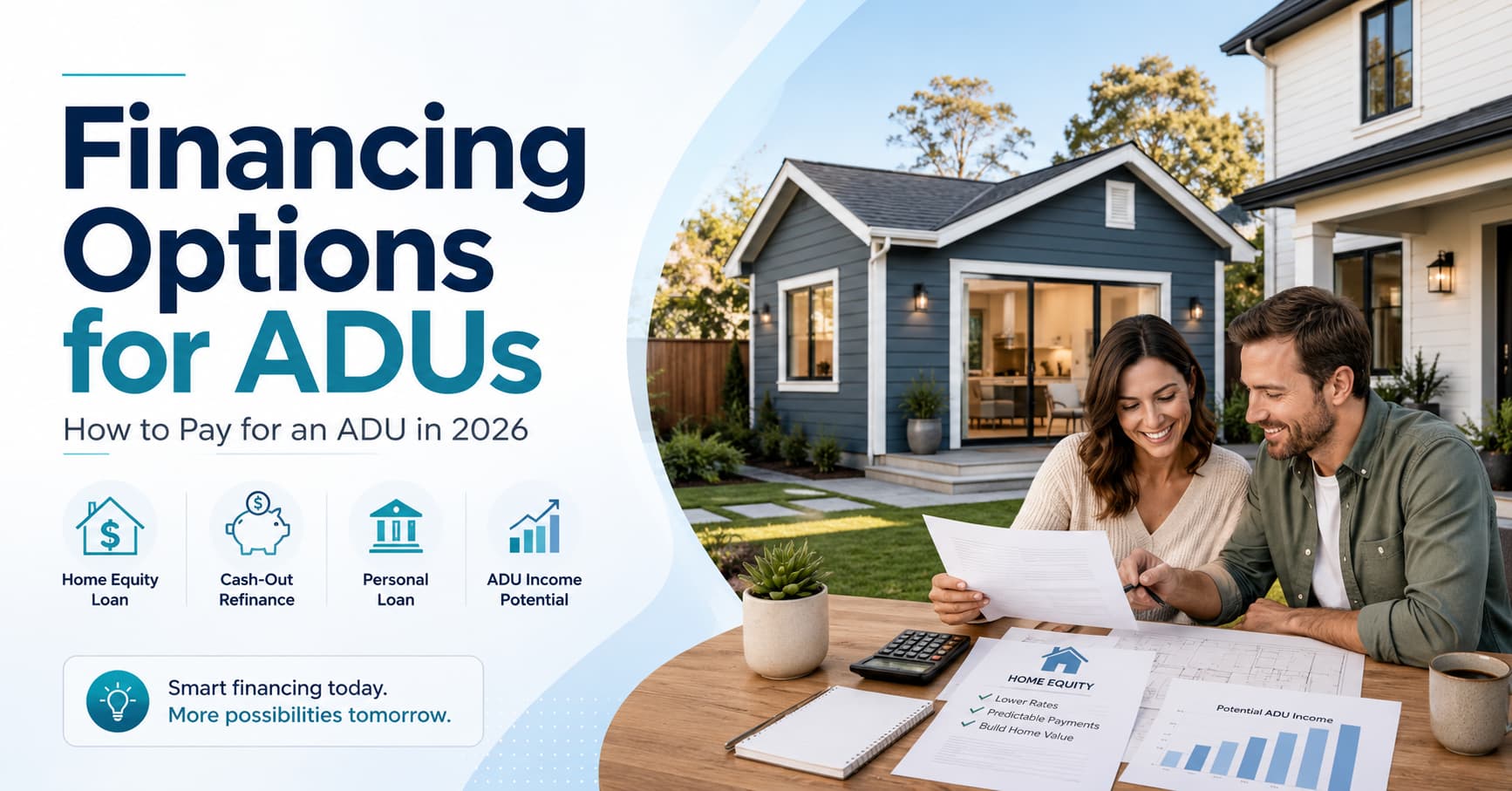
Financing is usually the hardest part of building an ADU.
Permits are complicated. Design takes time. Contractors are expensive. But the real question for most homeowners is more basic: how do I actually pay for this?
An accessory dwelling unit is not a normal remodel. It is part home improvement, part real estate investment, part rental-income project, and sometimes part family housing plan. That means the best financing option is not always the loan with the lowest rate. The best option is the one that matches your equity, income, construction timeline, risk tolerance, and long-term goal for the unit.
In 2026, most ADU financing still comes from homeowner equity. That can mean a HELOC, home equity loan, cash-out refinance, renovation mortgage, construction loan, or a mix of cash and debt. But the financing landscape is also getting better. Fannie Mae, Freddie Mac, FHA, MassHousing, San Diego, Boston, Portland, California HCD, and other public agencies now have ADU-specific resources or programs that did not exist, or were less developed, a few years ago.
This guide explains the main ADU financing options in 2026, how owner equity works, how much you may be able to borrow, what monthly payments can look like, how rental income may help, and how to avoid the most expensive financing mistakes.
Important disclaimer: This guide is for general education, not financial, legal, tax, mortgage, accounting, or investment advice. Loan rules, rates, grant availability, income limits, and local ADU programs change often. Always confirm details with a licensed mortgage professional, financial advisor, tax professional, local housing agency, and your city or county before making decisions.
Quick answer: What is the best way to finance an ADU?
For many homeowners, the most practical ADU financing option is one of these:
| Homeowner situation | Usually worth exploring first | Why |
|---|---|---|
| You have a low-rate first mortgage and strong home equity | HELOC or home equity loan | Lets you keep your existing mortgage instead of refinancing the entire balance |
| You have a higher-rate mortgage or need one loan for everything | Cash-out refinance or renovation refinance | Can simplify the structure if the new rate is not much worse than your current mortgage |
| You are buying a home and want to build or renovate an ADU | Renovation mortgage or construction-to-permanent loan | Can combine purchase and improvement costs into one financing plan |
| You are doing major structural work | Standard FHA 203(k), HomeStyle Renovation, CHOICERenovation, or construction loan | Designed for bigger renovation projects with contractor draws |
| You need flexibility during construction | HELOC or construction loan | Draw funds as needed instead of borrowing all at once |
| You are income-qualified in a city or state with ADU assistance | Local ADU loan, grant, or forgivable loan program | Can reduce cost, but usually comes with rules and restrictions |
| You have cash but do not want to drain reserves | Cash plus a smaller HELOC or home equity loan | Keeps liquidity and reduces total interest cost |
| You plan to rent the ADU | Loan structure based on net rent coverage | Rental income should be stress-tested before you borrow |
There is no single best ADU loan. A homeowner with a 3% first mortgage, $400,000 of equity, and stable income should think very differently than a homeowner buying a fixer-upper, a retiree adding a unit for family, or an investor trying to create long-term rental income.
Before choosing the loan, make sure you understand the project budget. Start with ADUWizard’s 2026 ADU cost guide and our guide to ADU permits, because financing only works if the construction budget is realistic.
How much does an ADU cost to finance in 2026?
ADU costs vary by location, unit type, site complexity, utilities, finishes, and whether you are converting existing space or building new construction.
Here are practical 2026 planning ranges:
| ADU type | Rough 2026 planning range | Financing note |
|---|---|---|
| Interior JADU or small internal conversion | $40,000 to $120,000 | Often small enough for cash, a small HELOC, or local assistance |
| Basement conversion | $75,000 to $200,000 | Moisture, egress, ceiling height, and plumbing can change the budget fast |
| Garage conversion | $90,000 to $220,000 | Often cheaper than detached, but old slabs, foundations, and utilities can surprise homeowners |
| Attached ADU addition | $150,000 to $325,000 | Structural tie-ins, roof work, and energy code make it more like a major addition |
| Detached backyard ADU | $180,000 to $450,000 | Usually needs foundation, utilities, site work, full plan set, and full inspections |
| Above-garage ADU | $250,000 to $500,000+ | Can be expensive because of structural upgrades, stairs, fire separation, and engineering |
| Prefab or modular ADU | $140,000 to $350,000+ all-in | The unit price is not the full price. Site work, permits, utility hookups, and foundation still matter |
| High-cost coastal, hillside, wildfire, or custom ADU | $350,000 to $600,000+ | Financing should include a larger contingency and more time for permits and utilities |
These are not quotes. They are planning ranges. A 500-square-foot garage conversion in a straightforward market may cost less than $120,000. A 750-square-foot detached ADU in Los Angeles, San Diego, the Bay Area, Portland, Seattle, Boston, or a coastal market can easily move above $300,000 once soft costs, utility upgrades, and contingency are included.
For more location-specific numbers, see ADUWizard’s California ADU cost guide, Los Angeles ADU cost guide, Oregon ADU cost guide, Portland ADU cost guide, and Massachusetts ADU cost guide.
Do not finance only the contractor bid
A common mistake is to finance the contractor’s construction quote and forget the rest of the project.
For ADU financing, your real budget should include:
| Cost category | Typical planning range | Why it matters |
|---|---|---|
| Feasibility study | $500 to $5,000 | Helps identify zoning, utility, septic, slope, and permit issues early |
| Survey | $1,000 to $5,000+ | Important when setbacks, easements, or lot lines are tight |
| Design and architecture | $5,000 to $30,000+ | Custom detached ADUs and additions cost more to design |
| Structural engineering | $2,500 to $12,000+ | Common for detached ADUs, additions, above-garage units, and conversions |
| Energy documentation | $500 to $3,000+ | Required in many jurisdictions, especially California |
| Permit and plan check fees | $2,000 to $20,000+ | Varies widely by city and project valuation |
| School, impact, or utility fees | $0 to $30,000+ | May be waived or limited in some states, but not always |
| Utility upgrades | $5,000 to $75,000+ | Electrical panel, sewer lateral, water service, trenching, septic, gas, transformer work |
| Construction hard costs | $80,000 to $450,000+ | Framing, foundation, finishes, labor, trades, appliances |
| Temporary housing or lost use | Varies | Important for interior conversions or major disruptions |
| Insurance and tax changes | Varies | ADUs can affect coverage and property taxes |
| Contingency | 10% to 20% of total budget | ADUs often reveal hidden site or utility conditions |
| Financing and closing costs | 1% to 5%+ depending on loan | Appraisal, title, origination, points, draws, inspections, lender fees |
A useful rule: if your contractor bid is $220,000, your real financing target may be closer to $260,000 to $300,000 once soft costs, utility risk, financing fees, and contingency are included.
Boston’s ADU Financial Assistance Program gives homeowners a useful benchmark. The city tells applicants that $275 per square foot is a good rule of thumb for scoping a preliminary build, using the example of an 800-square-foot ADU at $220,000. It also says contractor quotes below $100,000 will be scrutinized. That does not mean every ADU costs $275 per square foot, but it is a helpful reality check from a public agency in a high-cost market. See the Boston ADU Financial Assistance Program.
Owner equity explained: the key to most ADU financing
Most ADU financing starts with owner equity.
Owner equity is the difference between what your home is worth and what you still owe against it.
Basic formula:
Home value - mortgage balance and liens = owner equity
Example:
| Item | Amount |
|---|---|
| Estimated home value | $900,000 |
| Current first mortgage balance | $420,000 |
| Other liens | $0 |
| Total owner equity | $480,000 |
That homeowner has $480,000 of equity on paper.
But that does not mean the homeowner can borrow $480,000. Lenders usually cap total debt against the home using a loan-to-value ratio, or LTV, and combined loan-to-value ratio, or CLTV.
What is LTV?
LTV means loan-to-value. It compares one loan to the home value.
Loan amount / home value = LTV
A $500,000 mortgage on a $900,000 home is about 56% LTV.
What is CLTV?
CLTV means combined loan-to-value. It compares all loans secured by the home to the home value.
All mortgage debt / home value = CLTV
If you have a $420,000 first mortgage and add a $250,000 HELOC, total debt becomes $670,000.
$670,000 / $900,000 = 74.4% CLTV
That may be acceptable to many lenders if your credit, income, appraisal, and debt-to-income ratio also qualify.
How much ADU equity can you actually use?
Here is a simple equity calculation:
| Scenario | Home value | Current mortgage | Max CLTV | Max total debt | Estimated usable equity before fees |
|---|---|---|---|---|---|
| Strong equity | $900,000 | $420,000 | 80% | $720,000 | $300,000 |
| Higher leverage allowed | $900,000 | $420,000 | 90% | $810,000 | $390,000 |
| Limited equity | $650,000 | $510,000 | 80% | $520,000 | $10,000 |
| Free and clear home | $750,000 | $0 | 80% | $600,000 | $600,000, subject to income and underwriting |
This is why two homeowners with the same income can have very different ADU financing options. The first homeowner may be able to finance a detached ADU through equity. The second homeowner may need cash, a local program, a smaller conversion project, a co-borrower, or a different plan.
Important: equity is not the same as cash flow
A homeowner can have a lot of equity but still fail to qualify for a loan if monthly income cannot support the payment.
Lenders also look at:
- Credit score
- Debt-to-income ratio
- Employment or self-employment income
- Existing mortgage payment
- Property taxes and insurance
- HOA dues
- Existing debts
- New loan payment
- Reserves after closing
- Appraised value
- Construction budget
- Contractor documents
- Permits and plans
That is why ADU financing should be checked early, before spending heavily on final plans.
Current 2026 rate context for ADU borrowers
Rates change weekly, so do not treat the numbers below as a quote. They are useful because they show the relationship between common financing options.
As of late April and early May 2026:
| Product | Recent market reference | What it means for ADU financing |
|---|---|---|
| 30-year fixed mortgage | 6.30% average in Freddie Mac’s April 30, 2026 PMMS | Relevant for cash-out refinances, purchase loans, and some renovation mortgages |
| 15-year fixed mortgage | 5.64% average in Freddie Mac’s April 30, 2026 PMMS | Lower rate, higher payment |
| HELOC | 7.26% national average on May 6, 2026, according to Bankrate | Flexible draw, usually variable rate |
| Home equity loan | 8.03% national average on May 6, 2026, according to Bankrate | Fixed payment, often higher than first mortgage rates |
| Personal loan | 12.27% average in Bankrate’s May 6, 2026 comparison table | Usually too expensive for a full ADU, but possible for small gaps |
| Credit card | 19.57% average in Bankrate’s May 6, 2026 comparison table | Usually a bad idea for ADU construction except tiny short-term charges paid off immediately |
For weekly mortgage-rate updates, use Freddie Mac’s Primary Mortgage Market Survey. For consumer credit data, the Federal Reserve publishes G.19 Consumer Credit. For home equity rates, check current lender quotes and national surveys such as Bankrate’s HELOC rate page and home equity loan rate page.
Monthly payment examples for ADU financing
Here are simplified principal-and-interest examples. They exclude property taxes, insurance, lender fees, closing costs, mortgage insurance, points, draw fees, and rate changes.
| Loan amount | 6.30% for 30 years | 7.25% for 15 years | 8.00% for 15 years | 5.25% for 20 years |
|---|---|---|---|---|
| $50,000 | $309/mo | $456/mo | $478/mo | $337/mo |
| $100,000 | $619/mo | $913/mo | $956/mo | $674/mo |
| $150,000 | $928/mo | $1,369/mo | $1,433/mo | $1,011/mo |
| $200,000 | $1,238/mo | $1,826/mo | $1,911/mo | $1,348/mo |
| $250,000 | $1,547/mo | $2,282/mo | $2,389/mo | $1,685/mo |
| $300,000 | $1,857/mo | $2,739/mo | $2,867/mo | $2,022/mo |
This table shows why loan structure matters. A $250,000 ADU loan can feel very different depending on whether it is amortized over 15, 20, or 30 years.
A HELOC may start with interest-only payments during the draw period. For example, a $200,000 interest-only HELOC at 7.26% would cost about $1,210 per month in interest only. But that is not the full story. When the repayment period begins, the payment can jump because the loan starts amortizing.
Can future ADU rent help you qualify for financing?
Sometimes, yes. This is one of the most important changes in ADU financing.
FHA, Fannie Mae, and Freddie Mac have all become more ADU-aware. The details vary by loan type, property type, occupancy, appraisal, rental history, and lender overlays.
FHA and ADU rental income
HUD’s Mortgagee Letter 2023-17 updated FHA policies for ADUs. In general, FHA can allow rental income from an ADU to be considered in qualifying if documentation requirements are met. For a one-unit property with an ADU and limited or no rental history, FHA requires market-rent documentation through appraisal forms such as the Uniform Residential Appraisal Report and a comparable rent schedule. HUD also states that the amount of rental income from an ADU used as effective income must not exceed 30% of the borrower’s total monthly effective income.
HUD’s policy also uses a 75% calculation for certain rental-income underwriting situations, based on the lesser of appraiser-supported fair market rent or the rent in the lease or rental agreement. Read the official HUD document here: FHA Mortgagee Letter 2023-17.
Fannie Mae and ADU financing
Fannie Mae says its Selling Guide loan products can be used to purchase homes with ADUs, renovate an existing ADU, or add an ADU to a borrower’s existing home. Fannie Mae also points to HomeStyle Renovation for adding an ADU and construction-to-permanent financing for building a new home with an ADU. See Fannie Mae’s official Accessory Dwelling Units page.
Freddie Mac and ADU financing
Freddie Mac says it allows financing of properties with ADUs through all its mortgage offerings and that rental income generated by an ADU can be used as qualifying income if requirements are met. Freddie Mac also identifies CHOICERenovation as an option to add or renovate an ADU. See Freddie Mac’s official Accessory Dwelling Units page.
Practical warning about projected rent
Do not assume a lender will count 100% of future ADU rent.
A lender may discount projected rent, require a rent schedule, require an executed lease, require reserves, exclude short-term rental income, or apply stricter internal rules. A lender may also treat a newly built ADU differently from an existing permitted ADU with documented rental history.
For rental estimates, use multiple sources:
- HUD Fair Market Rents
- Local long-term rental listings
- Property manager estimates
- Comparable permitted ADU rentals
- Local affordable-rent limits if using a public program
- A conservative vacancy and maintenance assumption
The simple ADU cash-flow test
Before borrowing, run a conservative rental test.
Example:
| Item | Amount |
|---|---|
| Estimated monthly ADU rent | $2,200 |
| Vacancy reserve, 5% | -$110 |
| Maintenance reserve, 8% | -$176 |
| Property management, 8%, if used | -$176 |
| Extra insurance, taxes, utilities, bookkeeping estimate | -$150 |
| Estimated net monthly income before loan payment | $1,588 |
Now compare that to debt payments:
| Financing example | Monthly payment | Estimated monthly surplus or shortfall before income tax |
|---|---|---|
| $200,000 at 6.30% for 30 years | $1,238 | +$350 |
| $200,000 at 7.25% for 15 years | $1,826 | -$238 |
| $250,000 at 6.30% for 30 years | $1,547 | +$41 |
| $250,000 at 8.00% for 15 years | $2,389 | -$801 |
This does not mean a 15-year loan is bad. It means it may require stronger household cash flow. A shorter loan can build equity faster and reduce total interest, but it may not be rental-neutral in the early years.
1. Cash and savings
Cash is the cleanest ADU financing option because there is no loan approval, interest rate, draw schedule, appraisal, or lender inspection.
Best for:
- Smaller interior conversions
- JADUs
- Soft costs before loan approval
- Homeowners with strong reserves
- Avoiding debt
- Combining with grants or a small HELOC
Pros:
- No interest cost
- No lender underwriting
- No monthly payment
- More contractor flexibility
- No lien added to the home
Cons:
- Can drain emergency savings
- May reduce liquidity during construction
- Opportunity cost if the money could be invested elsewhere
- Risky if project overruns are large
My view: cash is great for feasibility, design, permits, and small projects. For a full detached ADU, I usually do not like seeing homeowners spend all available cash unless they still keep a serious emergency reserve.
2. HELOC for ADU construction
A home equity line of credit, or HELOC, is one of the most common ADU financing tools. It gives you a revolving line secured by your home. You can draw funds as needed during the draw period, which can be useful because ADU costs come in phases.
Best for:
- Homeowners with strong equity
- Homeowners who want to keep a low-rate first mortgage
- Projects with staged payments
- Borrowers who want flexibility
- Smaller to mid-size ADUs
- Construction gap funding
Pros:
- You draw only what you need
- Often interest-only during the draw period
- Can work well with contractor progress payments
- Usually lower rate than unsecured debt
- Lets you preserve an existing low-rate first mortgage
Cons:
- Usually variable rate
- Payment can rise later
- Lender may freeze or reduce line in some market conditions
- Requires home equity, credit, and income qualification
- You can overborrow if not disciplined
A HELOC is often the best ADU tool when the homeowner has a low first mortgage rate. If your current mortgage is 3.25%, a cash-out refinance at 6.5% or more may be expensive because it replaces the entire mortgage. A HELOC lets you borrow only the ADU portion.
3. Home equity loan
A home equity loan is a second mortgage with a fixed loan amount, fixed rate, and fixed payment.
Best for:
- Homeowners who want payment certainty
- Homeowners who know the full project cost
- Borrowers who dislike variable-rate HELOC risk
- Projects where most funds are needed quickly
Pros:
- Fixed monthly payment
- Fixed rate
- Predictable payoff schedule
- Keeps existing first mortgage in place
- Usually lower cost than personal loans or credit cards
Cons:
- Less flexible than a HELOC
- You borrow the full amount upfront
- Interest starts on the full amount immediately
- Can be hard if project costs change significantly
- Closing costs and appraisal may apply
For ADUs, a home equity loan works best when the design is permitted, contractor bids are solid, contingency is included, and the homeowner does not expect many changes.
4. Cash-out refinance
A cash-out refinance replaces your existing mortgage with a new, larger mortgage. You receive the difference in cash, which can be used for the ADU.
Best for:
- Homeowners with higher existing mortgage rates
- Homeowners who want one mortgage instead of two
- Borrowers who need a large lump sum
- Homeowners whose current loan terms are not attractive
- ADU projects where long-term amortization matters
Pros:
- One monthly mortgage payment
- Can offer 30-year amortization
- May be cheaper than second-lien debt if your existing rate is already high
- Can access significant equity if appraisal supports it
Cons:
- Replaces your entire first mortgage
- Can be a bad deal if you currently have a low rate
- Closing costs can be large
- Resets the mortgage term
- Increases debt secured by the home
Cash-out refinance example
Assume a homeowner owes $500,000 on a first mortgage at 3.25%. The monthly principal-and-interest payment on a 30-year loan at that rate is roughly $2,176.
If the homeowner refinances into a new $750,000 mortgage at 6.50%, the new principal-and-interest payment is roughly $4,741. That is an increase of about $2,565 per month before taxes, insurance, and closing costs.
That does not automatically make cash-out refinancing wrong. But it shows why homeowners with older low-rate mortgages often look first at HELOCs or home equity loans.
5. Fannie Mae HomeStyle Renovation
Fannie Mae’s HomeStyle Renovation mortgage can be used for renovations, including adding an ADU. Fannie Mae’s ADU page specifically says borrowers looking to purchase or refinance a one-unit property and construct or install a new ADU can use a renovation loan to finance it.
Best for:
- Purchase plus ADU renovation
- Refinance plus ADU construction
- Borrowers who want one mortgage product tied to after-improved value
- Larger projects where a lender-managed renovation process is acceptable
Pros:
- Can finance improvements as part of the mortgage
- May use after-renovation value in underwriting
- Useful when existing equity is not enough for a standard HELOC
- Can work for major ADU projects if guidelines are met
Cons:
- More paperwork than a standard mortgage
- Contractor approval and draw process
- Appraisal complexity
- Lender overlays may apply
- Not every lender is experienced with ADUs
Official resource: Fannie Mae HomeStyle Renovation.
6. Freddie Mac CHOICERenovation
Freddie Mac’s CHOICERenovation mortgage can help borrowers purchase or refinance and renovate. Freddie Mac’s ADU page specifically mentions CHOICERenovation for adding a new ADU or renovating an existing one.
Best for:
- Purchase or refinance with ADU renovation
- Converting an old garage, barn, shed, or other structure into an ADU
- Borrowers who want a conventional renovation mortgage option
- Homeowners who may also include resilience or energy upgrades
Pros:
- ADU-aware product path
- Can pair home financing and renovation financing
- May help when projected post-renovation value supports the loan
- Freddie Mac also has GreenCHOICE for certain energy improvements
Cons:
- Lender experience matters
- Requires careful contractor and scope documentation
- Draw process can slow construction if poorly managed
- Appraisal and project documentation can be demanding
Official resource: Freddie Mac Accessory Dwelling Units.
7. FHA 203(k) for ADUs
An FHA 203(k) loan lets homebuyers and homeowners finance the purchase or refinance of a home plus eligible rehabilitation costs. HUD describes 203(k) as a program where part of the proceeds pay the seller or refinance the existing mortgage, and the remaining funds go into an escrow account and are released as rehabilitation is completed.
There are two broad types:
| FHA 203(k) type | Best use | ADU financing note |
|---|---|---|
| Limited 203(k) | Smaller, non-structural improvements | HUD’s current page says Limited 203(k) permits up to $75,000 for repairs, improvements, or upgrades |
| Standard 203(k) | Major rehab and structural work | More relevant for serious ADU work, but usually requires more oversight and paperwork |
Best for:
- Owner-occupants
- Buyers purchasing a property that needs work
- Homeowners who need a government-backed renovation mortgage
- Projects where FHA underwriting is a better fit than conventional options
Pros:
- Government-backed renovation option
- Can finance acquisition or refinance plus rehab
- May help borrowers with lower down payment or credit profile than some conventional products
- FHA has become more ADU-aware in its rental-income policies
Cons:
- Owner-occupancy requirements
- FHA mortgage insurance
- More process and documentation
- Contractor and consultant requirements may apply
- Not every ADU scope fits easily
- Lender overlays can be stricter than FHA minimums
Official resources:
- HUD 203(k) Rehabilitation Mortgage Insurance Program
- HUD 203(k) Program Types
- FHA Mortgagee Letter 2023-17 on ADUs
8. Construction loans and construction-to-permanent financing
A construction loan funds the build itself. A construction-to-permanent loan converts into a long-term mortgage after construction is complete.
Best for:
- Detached new construction ADUs
- Large ADUs
- Custom projects
- New home plus ADU builds
- Borrowers with limited cash but strong plans, permits, contractor bids, and appraisal support
Pros:
- Designed for construction draws
- Can fund larger projects
- May use future completed value
- Construction-to-permanent structure avoids needing a separate takeout loan
Cons:
- More underwriting and documentation
- Requires detailed budget and contractor review
- Draw inspections can slow payment if not managed well
- Rates and fees may be higher
- Some lenders do not like small ADU-only construction loans
For many ADU builders, the hardest part is finding a lender that actually understands small residential construction. A local credit union, community bank, or ADU-experienced mortgage broker may be more useful than a national call-center lender.
9. Local ADU loans, grants, forgivable loans, and fee waivers
Public ADU programs can be extremely helpful, but they are not the same as free money.
They often come with:
- Income limits
- Owner-occupancy requirements
- Rent restrictions
- Long-term affordability covenants
- Application windows
- Limited funding
- Construction monitoring
- Required workshops or technical assistance
- Permit-ready project requirements
- Restrictions on short-term rentals
Here are useful 2026 examples.
California HCD and CalHFA ADU funding resources
California HCD’s ADU funding page points homeowners to the CalHFA ADU Grant Program, which provides up to $40,000 in assistance to reimburse predevelopment costs necessary to build and occupy an ADU. HCD also lists other possible state and local incentives, including CalHome, Local Housing Trust Fund, CDBG-related programs, San Diego, Clovis, Santa Cruz County, San Mateo County, Monterey Bay, San Jose, Chico, and Housing Trust Silicon Valley.
Official resource: California HCD Funding for ADUs.
Important note: grant funding can open, close, pause, or run out. Do not build your financing plan around a California ADU grant unless the program administrator confirms funds are currently available and you meet all requirements.
San Diego Housing Commission ADU Finance Program
The San Diego Housing Commission’s ADU Finance Program is one of the strongest local examples in the U.S. The program offers loans of up to $250,000 to qualified income-eligible homeowners in the City of San Diego, plus technical assistance at no cost. The program page lists eligibility details including income up to $231,000, owner occupancy, a minimum credit score of 680, and an application fee of $2,500 after approval and due at closing. It also requires rents to be restricted to households earning up to 80% of AMI for at least 7 years.
Official resource: SDHC ADU Finance Program.
MassHousing ADU Loan Program
MassHousing’s Accessory Dwelling Unit Loan Program provides second mortgage loans to income-eligible homeowners. The program offers loans of up to $250,000 for detached ADUs and up to $150,000 for attached ADUs. Funds must be used for ADU construction costs, and homeowners must have plans, permits, and predevelopment materials in hand before applying.
Official resource: MassHousing ADU Loan Program.
Massachusetts MHP ADU Incentive Program
The Massachusetts Housing Partnership ADU Incentive Program is designed to provide outreach, education, technical assistance, and financial assistance. Phase One is expected to focus on feasibility studies for homeowners.
Official resource: MHP ADU Incentive Program.
Boston ADU Financial Assistance Program
Boston’s program offers income-eligible owner-occupants support for planning, permitting, and construction. The program includes a technical assistance grant of up to $7,500 and a Boston Home Center ADU Loan with gap funding of up to $50,000. The ADU loan is listed as 0% interest and deferred, becoming due if the owner sells, transfers ownership, or does a cash-out refinance.
Official resource: Boston ADU Financial Assistance Program.
Portland ADU SDC waiver
Portland’s ADU System Development Charge waiver is not a loan, but it can reduce upfront cost. It applies to new ADUs that are owner-occupied or rented month-to-month or longer. It does not apply to short-term rentals. The waiver requires a 10-year covenant, and Portland says violating or revoking the covenant requires payment of 150% of current SDC fees.
Official resource: Portland ADU SDC Waiver.
Santa Cruz County ADU forgivable loan
Santa Cruz County has offered forgivable loans up to $40,000 for homeowners who rent ADUs to low-income households at affordable rents for up to 20 years. Always confirm current availability before relying on the program.
Reference: Santa Cruz County ADU Forgivable Loan Program.
10. Contractor financing
Some ADU builders, prefab companies, and design-build firms offer financing through lending partners.
Best for:
- Homeowners who want a convenient quote-and-financing process
- Prefab or modular ADU packages
- Smaller gaps in the financing stack
- Borrowers who have not yet shopped lenders
Pros:
- Convenient
- Fast prequalification
- Sometimes tied to a specific construction package
- May help compare monthly payment against scope
Cons:
- Not always the cheapest capital
- Terms can be less flexible
- The contractor has an incentive to make financing feel easy
- You still need to compare outside lenders
- May not cover site work, utility upgrades, permits, or change orders
Never choose a contractor just because financing is convenient. Compare the total project price, financing terms, contractor experience, exclusions, lien waivers, warranty, and payment schedule.
11. Personal loans
A personal loan is unsecured debt. It does not use the home as collateral, which sounds attractive, but the rate is usually higher and the loan size is usually smaller.
Best for:
- Small funding gaps
- Design or permitting costs
- Appliances or finishes
- Emergency overages that can be paid off quickly
Pros:
- Fast approval
- No home lien
- Fixed payment in many cases
- No appraisal
Cons:
- Higher rates
- Shorter repayment terms
- Smaller loan amounts
- Can hurt debt-to-income ratio
- Usually not suitable for a full ADU
A personal loan may be reasonable for a $10,000 to $40,000 gap. It is usually not the best way to finance a $250,000 detached ADU.
12. Credit cards
Credit cards are usually the wrong way to finance an ADU.
They may make sense only for:
- Small purchases
- Appliances
- Permit fees if rewards make sense and the card is paid off immediately
- Short-term bridge spending with cash already available
They are dangerous for:
- Contractor payments
- Long-term balances
- Change orders
- Utility upgrades
- “I will pay it off when the ADU rents” thinking
With credit card APRs often far above mortgage and home equity rates, carrying a balance can turn an ADU overrun into a serious financial problem.
13. Retirement account loans
Some homeowners consider a 401(k) loan or other retirement account strategy.
This can be tempting because you are borrowing from yourself. But it can also be risky.
Potential advantages:
- No mortgage lien
- Fast access if allowed by plan
- Interest may be paid back to your own account
Risks:
- Reduced retirement growth
- Repayment pressure
- Tax and penalty risk if employment ends or the loan defaults
- Not available in all plans
- Can create long-term opportunity cost
I would treat retirement funds as a last-resort or gap strategy, not the main way to finance an ADU.
14. Family loans or private financing
A family loan can be useful when it is documented properly.
Best for:
- Multigenerational ADUs
- Parent-child housing arrangements
- Family-funded aging-in-place plans
- Gap financing before a refinance
Pros:
- Flexible terms
- May be cheaper than market debt
- Can align with family housing goals
- May avoid bank underwriting delays
Cons:
- Relationship risk
- Gift tax and tax reporting issues
- Estate planning complications
- Informal agreements can create disputes
- A lender may need to know about the debt if you also apply for a mortgage
If family money is involved, use a written promissory note, define repayment, clarify ownership expectations, and talk to a tax or estate professional.
15. Investor, DSCR, and rental-property loans
Some borrowers build ADUs primarily for rental income. Investors may look at DSCR loans, private loans, or rental-property financing.
Best for:
- Non-owner-occupied rental properties
- Investors with strong rental cash flow
- Properties with existing rental income
- Borrowers who cannot qualify using traditional personal income but have strong property income
Pros:
- Can focus more on property cash flow
- Useful for rental portfolios
- May work where owner-occupant products do not
Cons:
- Higher rates and fees
- Larger down payment or equity requirements
- Not all lenders understand ADUs
- Short-term rental income may be discounted or excluded
- Local ADU laws may restrict use
Investors should be extra careful with ADU legal status. A nonpermitted unit, illegal rental use, or short-term-rental restriction can break the financing model.
16. Hard money and bridge loans
Hard money and bridge loans are short-term, higher-cost loans.
Best for:
- Experienced investors
- Very short-term financing gaps
- Projects with a clear refinance or sale plan
- Situations where speed matters more than cost
Pros:
- Fast
- Flexible
- May rely more on property value than borrower profile
- Can fund projects traditional lenders avoid
Cons:
- High rates and fees
- Short maturity
- Refinance risk
- Not homeowner-friendly in many cases
- Dangerous if permits, construction, or lease-up take longer than expected
Most normal homeowners should be cautious here. ADUs are small real estate projects, but they can still have big delays. A short-term expensive loan can become stressful if the city, utility, or contractor timeline slips.
17. PACE financing and energy-efficiency financing
Property Assessed Clean Energy, or PACE, may be available in some states for energy-related improvements. Some ADU projects also qualify for separate rebates or incentives for heat pumps, electrical upgrades, insulation, solar, or water heating.
Best for:
- Energy upgrades that are part of the ADU
- Heat pumps
- Solar
- Electrical work
- Insulation or weatherization
Pros:
- Can reduce energy-related project cost
- May not require the same underwriting as a traditional loan
- Can pair with other financing
Cons:
- PACE creates a property-tax assessment lien
- Can complicate sale or refinance
- Total cost may be high
- Not always available
- Not usually enough to finance the full ADU
For energy incentives, check the official federal Energy Star Rebate Finder, state energy office programs, and utility rebates.
18. Reverse mortgage or HECM for older homeowners
Some older homeowners consider using home equity to build an ADU for a caregiver, adult child, rental income, or aging-in-place plan.
A Home Equity Conversion Mortgage, or HECM, is a federally insured reverse mortgage for eligible older homeowners. It is not an ADU-specific product, but it can be part of a broader home-equity strategy for some households.
Potential fit:
- Homeowners age 62 or older
- Strong home equity
- Need to age in place
- Family or caregiver housing goal
- No desire to make traditional monthly mortgage payments
Risks:
- Reduces home equity over time
- Fees can be significant
- Must meet occupancy, tax, insurance, and property-maintenance obligations
- Can affect heirs and estate planning
- Not suitable without counseling and advice
This is not a casual ADU financing option. It should be discussed with a HUD-approved housing counselor, financial advisor, and family members who may be affected.
How to stack ADU financing
Many successful ADU projects use more than one funding source.
Example 1: Equity plus cash
| Source | Amount |
|---|---|
| Cash for design, permits, and early deposits | $35,000 |
| HELOC for construction draws | $210,000 |
| Contingency cash reserve | $30,000 |
| Total available | $275,000 |
Good for: homeowners who have equity but want to avoid borrowing every dollar.
Example 2: Local program plus bank loan
| Source | Amount |
|---|---|
| Local ADU loan or grant | $50,000 |
| Home equity loan | $175,000 |
| Cash | $25,000 |
| Total available | $250,000 |
Good for: income-eligible owner-occupants in cities with ADU assistance.
Example 3: Renovation mortgage plus energy rebates
| Source | Amount |
|---|---|
| Renovation mortgage | $260,000 |
| Utility or state energy rebates | $5,000 |
| Cash contingency | $25,000 |
| Total available | $290,000 |
Good for: borrowers who want one primary financing path and are adding efficiency upgrades.
Example 4: Cash now, refinance later
| Phase | Funding source |
|---|---|
| Design and permits | Cash |
| Construction | HELOC or construction loan |
| After completion | Refinance into permanent loan if terms make sense |
Good for: borrowers who need flexible construction funding but want a cleaner long-term structure.
Warning: do not assume the refinance will be available. Rates, appraisal, income, credit, rental documentation, and lender appetite can change.
ADU financing by project type
Detached ADU financing
Detached ADUs usually need the largest budget. The best financing options are often HELOCs, home equity loans, cash-out refinances, construction loans, Fannie/Freddie renovation products, or local ADU programs.
Key financing issue: utility and site-work risk. Detached units can trigger trenching, sewer, water, electrical, foundation, drainage, fire access, and transformer costs.
Garage conversion financing
Garage conversions are often easier to finance because the budget can be smaller. Cash, HELOCs, home equity loans, renovation loans, or local programs may work well.
Key financing issue: old garages are not always habitable. Lenders and appraisers may care whether the finished unit will be legal, permitted, and code-compliant.
Basement ADU financing
Basement ADUs can be financed with home equity, renovation products, or local assistance. They may be attractive in older East Coast and Midwest housing stock.
Key financing issue: egress, moisture, plumbing below grade, ceiling height, and fire separation.
Attached ADU financing
Attached ADUs may fit renovation loans or home equity products well because they are additions to the existing home.
Key financing issue: structural tie-in, roofline, fire separation, and disruption to the primary home.
Prefab ADU financing
Prefab ADU financing can include home equity products, construction loans, renovation loans, or manufacturer-linked financing.
Key financing issue: the advertised prefab price is not the all-in price. Always finance site work, foundation, utility connections, permits, delivery, crane access, sales tax if applicable, and contingency.
How lenders evaluate an ADU project
A lender may ask for more than a normal remodel file.
Expect some combination of:
- Credit report
- Income documentation
- Tax returns if self-employed
- Current mortgage statement
- Homeowners insurance
- Property tax statement
- Appraisal
- Construction contract
- Contractor license and insurance
- Plans and specifications
- Permit status
- Budget and draw schedule
- Contingency amount
- Title report
- Flood, wildfire, or hazard review if relevant
- Lease or rent schedule if using rental income
- Reserve documentation
For renovation or construction products, the lender may also require inspections before releasing draw payments.
The ADU financing decision matrix
Use this table as a starting point.
| Financing option | Best for | Avoid when |
|---|---|---|
| Cash | Small projects, soft costs, avoiding debt | It drains emergency reserves |
| HELOC | Flexible construction draws, keeping low first mortgage | You cannot handle variable-rate or payment-reset risk |
| Home equity loan | Fixed payment, known budget | Project scope is uncertain |
| Cash-out refinance | One mortgage, high existing mortgage rate, long amortization | You have a much lower current mortgage rate |
| HomeStyle Renovation | Conventional renovation financing | Your lender lacks ADU renovation experience |
| Freddie CHOICERenovation | Conventional renovation or refinance with ADU | You need a very simple loan with minimal documentation |
| FHA 203(k) | Owner-occupants, purchase or refinance plus rehab | You dislike FHA mortgage insurance or paperwork |
| Construction loan | Large detached or custom ADU | You do not have permits, plans, contractor, or appraisal support |
| Local grants or loans | Income-eligible homeowners | Restrictions make the rental or resale plan unattractive |
| Contractor financing | Convenience | Rate, fees, or exclusions are worse than outside options |
| Personal loan | Small gap | Full ADU construction |
| Credit card | Tiny short-term expenses paid off immediately | Any balance that will carry interest |
| Family loan | Multigenerational projects | Terms are vague or undocumented |
| Hard money | Experienced investors with clear exit | Normal homeowner ADU projects |
| PACE or energy financing | Energy upgrades | You plan to sell or refinance soon and the lien may complicate things |
The most expensive ADU financing mistakes
1. Borrowing before the permit path is clear
Do not lock yourself into expensive money before you know the ADU is feasible. Read ADUWizard’s ADU permits guide before borrowing heavily.
2. Ignoring utility upgrades
Electrical panels, sewer laterals, water service, septic systems, gas lines, trenching, and transformers can change the financing need dramatically.
3. Using gross rent instead of net rent
A $2,400 monthly rent is not $2,400 of spendable cash. Deduct vacancy, maintenance, property management, insurance, utilities, taxes, reserves, and loan payment.
4. Refinancing a low-rate mortgage too quickly
A cash-out refinance can be convenient, but replacing a 3% mortgage with a 6% to 7% mortgage on the full balance can be costly.
5. No contingency
ADUs need contingency. I would rather see a smaller ADU with a 15% contingency than a bigger ADU funded with no margin.
6. Counting on a grant before approval
Public programs can run out of money, change rules, or have waitlists. Treat grants as helpful, not guaranteed, until formally approved.
7. Forgetting tax and insurance changes
A legal ADU can affect property taxes, insurance, depreciation, rental reporting, and local registration requirements.
8. Not matching loan type to construction schedule
A lump-sum loan may be expensive if the project will take 12 months and funds are not needed all at once. A draw-based loan may be better, but only if the draw process works smoothly.
9. Financing an illegal rental strategy
If the ADU will be rented, confirm long-term rental rules, short-term rental restrictions, affordability covenants, and local registration before borrowing.
10. Choosing the maximum loan instead of the safest loan
The loan you qualify for is not always the loan you should take.
ADU financing checklist
Before applying for ADU financing, gather:
- Current mortgage statement
- Property tax bill
- Homeowners insurance declaration page
- Estimated home value
- Current credit score range
- Income documents
- Existing debt payments
- Preliminary ADU budget
- Feasibility study if available
- Site plan or concept plan
- Contractor estimate
- Soft-cost estimate
- Utility upgrade estimate
- Permit status
- Expected rent estimate
- Conservative cash-flow projection
- 10% to 20% contingency plan
- List of local grant or loan programs
- Exit strategy if construction runs over budget
My practical ADU financing strategy
If I were advising a homeowner, I would not start by asking, “What loan can you get?”
I would start with four questions:
- What is the cheapest ADU that still solves your real goal?
- How much usable equity do you actually have?
- Can your household afford the payment without depending on perfect rent?
- What happens if the project costs 15% more or takes six months longer?
That is the difference between financing an ADU and overleveraging your house.
For most homeowners, the strongest path is:
- Run a feasibility check.
- Estimate the real all-in cost.
- Calculate usable equity.
- Compare HELOC, home equity loan, cash-out refinance, renovation loan, and local programs.
- Stress-test monthly payments against conservative rent.
- Keep a cash reserve.
- Do not start construction until the financing, permit, and contractor scope line up.
Frequently asked questions about ADU financing
Can I use home equity to build an ADU?
Yes. Home equity is one of the most common ways to finance an ADU. You may be able to use a HELOC, home equity loan, cash-out refinance, renovation refinance, or construction loan. The amount depends on your home value, mortgage balance, credit, income, debt-to-income ratio, appraisal, and lender limits.
What is the easiest ADU loan to get?
For homeowners with strong equity and income, a HELOC or home equity loan is often the easiest. For buyers or owners who need renovation financing tied to future value, Fannie Mae HomeStyle Renovation, Freddie Mac CHOICERenovation, FHA 203(k), or a construction-to-permanent loan may be more appropriate.
Can I get a grant to build an ADU?
Possibly, but grants are local and limited. California HCD lists the CalHFA ADU Grant Program and several local programs. Boston, San Diego, Santa Cruz County, MassHousing, MHP, Portland, and other jurisdictions also have loans, grants, fee waivers, or technical assistance. Always confirm current availability.
Can ADU rental income help me qualify for a loan?
Sometimes. FHA, Fannie Mae, and Freddie Mac have pathways for ADU rental income, but rules vary. Lenders may require an appraisal rent schedule, lease, rental history, reserves, and legal ADU status. Projected rent is usually discounted and may be capped.
Is a HELOC better than a cash-out refinance for an ADU?
Often, yes, if you have a low-rate first mortgage. A HELOC lets you keep the original mortgage and borrow only the ADU amount. A cash-out refinance replaces the whole mortgage, which can be expensive if current rates are much higher than your existing rate.
Should I use a 15-year or 30-year loan for an ADU?
A 15-year loan usually has higher monthly payments but lower total interest. A 30-year loan usually has lower monthly payments but more lifetime interest. If the ADU will be a rental, compare the payment to conservative net rent, not gross rent.
Can I finance a prefab ADU?
Yes, but make sure the financing covers the full installed cost, not just the factory unit. Site work, foundation, permits, delivery, crane access, utility hookups, trenching, and local inspections can be a major part of the budget.
Can I use an FHA 203(k) loan for an ADU?
FHA 203(k) can be relevant for ADU-related rehabilitation, especially for owner-occupants. HUD’s FHA ADU policy updates also clarified ADU rental-income treatment. The fit depends on project type, occupancy, lender, and FHA rules.
Can I build an ADU with no money down?
Usually not. Even if a loan covers most construction costs, you may need cash for feasibility, plans, permits, reserves, contingencies, appraisal gaps, and costs that the lender will not finance. Local programs can help some income-qualified homeowners, but they rarely eliminate every out-of-pocket need.
What credit score do I need for ADU financing?
It depends on the loan. HELOCs and home equity loans often prefer stronger credit. FHA products can have more flexible baseline credit rules, but lenders may apply stricter overlays. Local programs may publish their own minimums. For example, San Diego’s SDHC ADU Finance Program lists a minimum credit score of 680.
How much rent should I assume from an ADU?
Use conservative long-term rent, not the highest short-term rental number you can find. Check HUD Fair Market Rents, local rental listings, ADU comps, and property manager estimates. Then subtract vacancy, maintenance, management, taxes, insurance, utilities, and reserves.
Is ADU financing tax deductible?
Interest deductibility depends on how the loan is used, how the ADU is used, whether it is rental or personal use, and current tax law. Talk to a tax professional before assuming interest, depreciation, or expense deductions.
Bottom line: finance the ADU like a small real estate project
An ADU can create rental income, family flexibility, aging-in-place options, and long-term property value. But it is still a real construction project secured by real money.
The smartest financing plan does three things:
- It covers the full project, not just the contractor bid.
- It protects the homeowner from rate, rent, permit, and construction surprises.
- It matches the loan structure to the ADU’s purpose.
If the goal is family housing, cash flow may matter less than safety and long-term affordability. If the goal is rental income, the loan payment must work against conservative net rent. If the goal is property value, the ADU must be legal, permitted, insurable, and attractive to future buyers.
The best ADU financing decision is not always the biggest loan or the lowest teaser payment. It is the structure that lets you finish the unit, pass final inspection, keep enough reserves, and still sleep at night.
Start with the real numbers. Then choose the loan.
Get your exact ADU cost — for your lot
Skip the averages. Enter your address and our wizard checks feasibility, estimates your real build cost, and matches you with vetted local builders.
No spam, ever · Trusted by 2,500+ homeownersExplore ADU costs by location
See real price ranges and permit timelines for your state or city.